Ordered by 15:00, shipped the same day! Free shipping starting CHF.- 80!



 B2b registration
  Client login
Chronic back pain is far more than just a pain in the back. For over half a billion people worldwide, it means a daily struggle and massive restrictions in quality of life. Current solutions such as opioids carry high risks of addiction. But there is hope from science: as reported by
Source: SRF News: Cannabis extract relieves chronic back pain
The study in focus: SRF confirms promising data
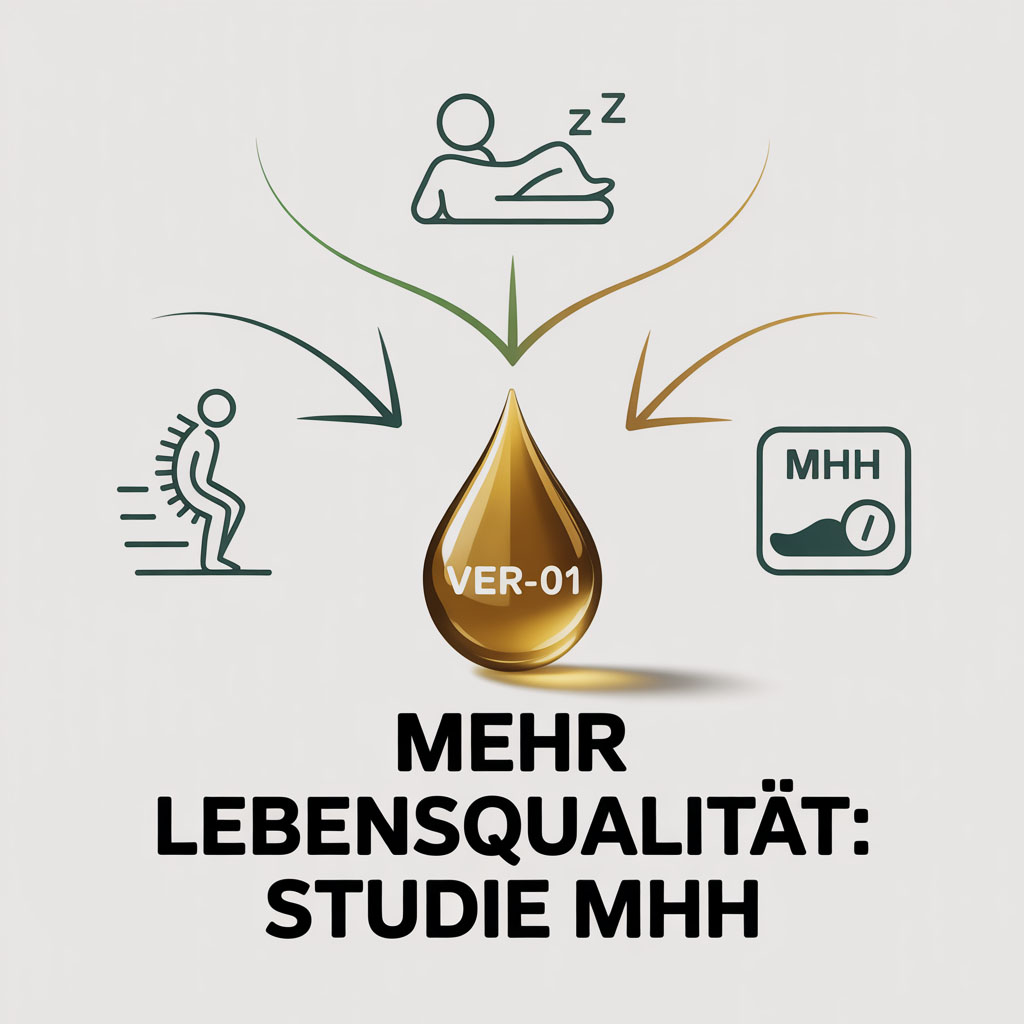
The SRF report is based on a large-scale study by Hannover Medical School (MHH), which was published in the renowned journal “Nature Medicine”. The SRF classifies the results as clinically highly relevant. The full cannabis extract “VER-01” was tested on over 800 patients. The result is clear:
Better quality of life: SRF also reports that not only did the pain decrease, but sleep and mobility also improved.
Less pain: The intensity of pain decreased significantly more in the cannabis group than in the placebo group (by almost 2 points on the pain scale).
Source: Nature Medicine (original study)
No high despite THC – the comparison with Nutella
One point that the SRF report particularly emphasizes is the safety of the application. Many patients fear the intoxicated state (“high”). However, study leader Matthias Karst gives the all-clear in the SRF interview: although the drug does contain THC, it takes effect slowly when taken orally. Neuroscientist Jan Vollert illustrates this in the report with an apt comparison: the difference between a joint and this drug is as great as that between “hazelnuts and Nutella”. This underlines the great advantage of liquid extracts over smoking: While a joint burns many substances, a carefully produced oil the profile of the plant is preserved and enables a clean, standardized application.
Source: SRF article: Interview with Matthias Karst and Jan Vollert
Side effects and tolerability: what patients need to know
Here too, the SRF report provides a transparent classification. Yes, there were side effects such as dizziness (approx. 40%) or tiredness (approx. 15%), but these mainly occurred at the beginning. After three weeks, the symptoms had disappeared in almost all participants. For SRF it is clear: compared to the severe side effects of opioids (high risk of addiction) or conventional painkillers (stomach/kidney damage), this is an acceptable profile for pain patients.

Classification for Switzerland: seriousness instead of clichés
The fact that a leading medium such as SRF is reporting on this study in such detail, objectively and in prime time is an important signal. It takes the topic of cannabis out of the dark corner and places it where it belongs: in modern science. For us as Swiss producers, this confirms our path. The study clearly shows that the future belongs to professionally processed extracts. Achieving such standards does not require garage cultivation, but expertise in the laboratory. It is precisely this extraction expertise that we rely on at Herba di Berna. We use gentle processes to capture the full spectrum of the hemp plant in our drops in our drops – for pure and controlled quality.
Conclusion on the topic of cannabis for back pain
As SRF concludes, the drug is a step in the right direction, even if it is not the only miracle cure. Physiotherapy and exercise remain important. But the study shows that cannabis extracts are a serious option that is scientifically proven.
Until such medicinal preparations are widely available, many people are already relying on the versatile power of the hemp plant and high-quality CBD extracts in everyday life. Want to delve deeper into the subject? We have summarized for you what science and experience have to say: Read our blog posts about the properties of CBD oils
List of sources:
The scientific publication of the study results on the efficacy and safety of cannabis extracts for chronic back pain. To the original publication (Nature.com)
SRF News – Cannabis extract relieves chronic back pain The detailed report from Radio SRF 4 News and SRF Online, including interviews with study director Prof. Dr. Matthias Karst and neuroscientist Dr. Jan Vollert. To the report on SRF.ch
Hannover Medical School (MHH) – Clinical study Background information on the large-scale study with the full cannabis extract, conducted by the Clinic for Pain Medicine. To the MHH press release
Häufige Fragen (FAQ) – Basierend auf dem SRF-Bericht
Auf welche Quelle bezieht sich dieser Beitrag?
We refer to a report by Radio SRF 4 News and SRF Online from 30.09.2025. SRF analyzed the results of a study by the Hannover Medical School (published in Nature Medicine). Source: To the SRF article
Macht das Medikament “high”?
No. SRF quotes experts who explain that oral ingestion does not cause intoxicating THC peaks in the blood. There is no intoxication, the pain-relieving effect occurs.
Warum ist die Berichterstattung von SRF wichtig?
SRF is considered a trustworthy source. Such objective reporting helps to dispel prejudices and focus attention on the medical benefits and quality assurance (“Swiss Made”).
Was sagt SRF zur Wirksamkeit bei Rückenschmerzen?
SRF reports that the cannabis extract tested (VER-01) relieved chronic back pain significantly more than a placebo. Patients were able to move better and sleep better again. Source: Nature Medicine study (English)
Wie ordnet SRF die Nebenwirkungen ein?
The report mentions side effects such as dizziness, but makes it clear that these mostly only occurred in the first three weeks and then disappeared. The addiction potential is estimated to be significantly lower than with opioids.
Ist das Medikament schon in der Schweiz zugelassen?
As can be seen from the report, this is a preparation that has not yet been approved and is currently in advanced clinical trials. However, it shows potential for the future.