Ordered by 15:00, shipped the same day! Free shipping starting CHF.- 80!


 B2b registration
  Client login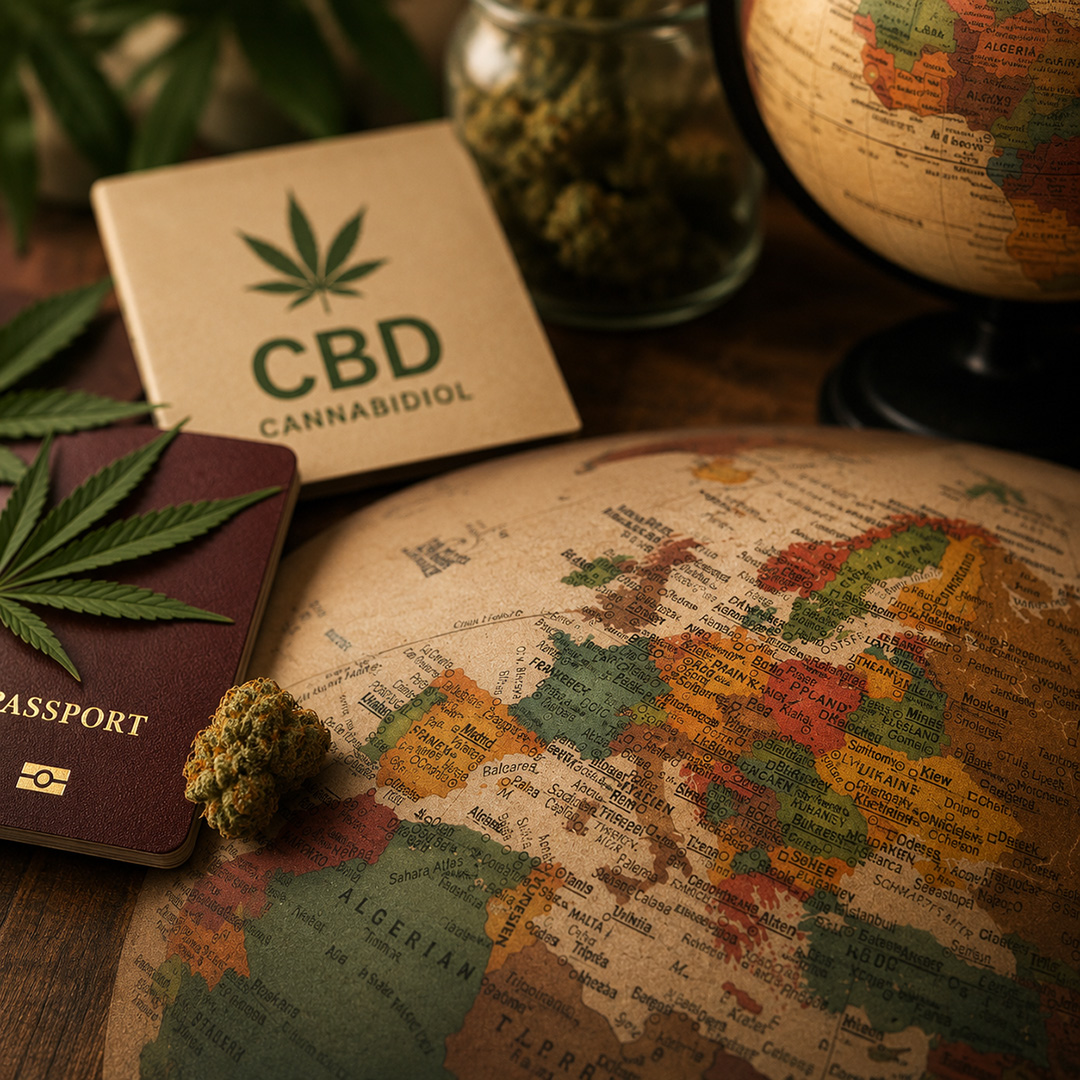
Traveling with CBD raises many questions. Are you allowed to take CBD products from Switzerland abroad? Do the same rules apply on a plane as they do in a car? And why can a product that’s completely legal in Bern still cause problems at the border?
It’s a good idea to do a quick legal check, especially before the holidays. In Switzerland, the THC limit for hemp products differs from that in many EU countries. While low-THC hemp containing less than 1 percent THC is not considered a narcotic in this country, other countries have lower limits, different product categories, or additional restrictions.
This article explains what travelers should keep in mind. It is not a substitute for legal advice, but it helps you assess CBD more realistically while traveling. It covers vacations, air travel, customs, EU countries, medical cannabis, and common product types such as CBD skincare products, flowers, hash, vapes, and liquid CBD products.
In a nutshell: Can you bring CBD with you when traveling?
Traveling with CBD is not automatically prohibited, but it is not automatically safe either. The key factors are the destination country, transit countries, product type, THC content, packaging, labeling, and the specific purpose of the product.
A Swiss product can be sold legally but still not comply with the regulations of another country. Unprocessed hemp products, such as CBD flowers and CBD hash, are particularly problematic because they are visually almost indistinguishable from THC-containing cannabis. Vapes, e-liquids, and other liquid products can also raise questions at the airport or at customs.
As a general rule of thumb: The more clearly a product is labeled, the lower its THC content, and the less conspicuous its legal classification, the lower the risk. Nevertheless, you should check the rules of your destination country before every trip.
Why Swiss CBD Can Cause Problems Abroad
Switzerland permits low-THC cannabis products under certain conditions, up to a limit of less than 1 percent THC. However, this limit does not automatically apply abroad. Many countries use lower limits, such as 0.2 or 0.3 percent THC. Other countries take a much stricter approach to certain types of products.
In addition, authorities don’t just evaluate lab results. Appearance, smell, packaging, and product labeling can also play a role. Anyone traveling with CBD flowers, CBD hash, or vape products should expect to be questioned.
That’s why it’s important to Herba di Berna: We provide transparent information rather than giving a false sense of security. If you’re unsure, it’s better not to take CBD products across the border—better safe than sorry. Within Switzerland, you’ll find the right categories—such as CBD skincare products or CBD accessories —right here on our site, with shipping from the heart of Switzerland to every corner of the country.
CBD When Traveling by Plane: Carry-On Luggage, Checked Luggage, and Liquids
When flying, two issues come into play: the legal status of CBD and the security rules for luggage. In Europe, liquids in carry-on luggage may generally only be carried in containers of up to 100 milliliters and must be placed in a transparent, resealable bag. This also applies to liquid or creamy products.
However, this aviation regulation does not address whether a CBD product is legal in the destination country. A product may be properly packaged as a liquid at security screening and pass through customs, but could still pose legal issues upon entry.
When traveling by plane, you should therefore check three things:
- Is it permitted to import or possess this type of product in the destination country?
- Second: Does the THC content comply with the regulations of the destination country?
- Third: Does the product comply with the airline’s and the airport’s baggage policies?
You should be especially careful with vapes and e-liquids. In addition to CBD regulations, there are often additional rules regarding batteries, e-cigarettes, liquids, and public use.
CBD While Traveling and Then Crossing the Border by Car
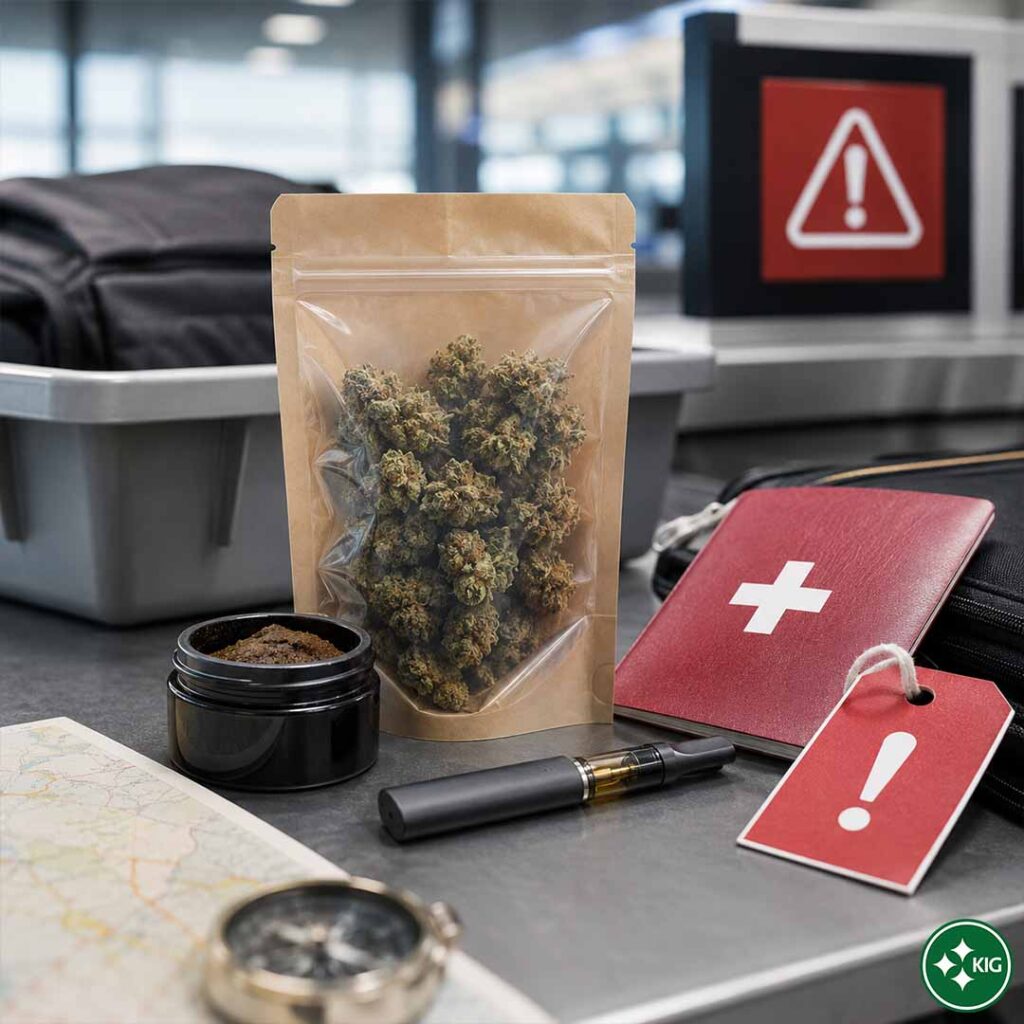
Many travelers from Switzerland drive to Germany, France, Italy, or Austria. This seems less complicated than flying, but it isn’t necessarily simpler from a legal standpoint. As soon as you cross a national border, customs and import regulations may apply.
It’s especially important to exercise caution with CBD flowers and CBD hash. These products look just like regular cannabis products with higher THC content. Even if lab results are available, verifying them can be inconvenient or time-consuming.
Anyone traveling by car should therefore carry only clearly labeled products and check in advance whether that type of product is actually permitted in the destination country. When traveling by car, the issue of driving ability is also important. Our separate article, “Cannabis and Driving in Switzerland,” covers this topic.
Which CBD products are particularly tricky to bring when traveling?
Not every CBD product carries the same risk. When planning a trip, it helps to clearly distinguish between different types of products.
CBD Flowers and CBD Hash
CBD flowers and CBD hash are particularly tricky to travel with. Even though they may be legally available in Switzerland and are generally accepted by society, an inspector cannot determine the THC content just by looking at them. Their smell, appearance, and texture may resemble those of illegal cannabis.
If you want to avoid trouble, don’t take these products abroad without careful consideration. If you’re generally interested in these types of products, you can find information about CBD flowers and CBD hash at Herba di Berna. However, when traveling for vacation, be sure to check the rules of your destination country beforehand.
CBD Skincare Products and Cosmetics
CBD skincare products tend to be less conspicuous when traveling because they are classified as cosmetics. Nevertheless, ingredients, packaging, liquid volume, and local CBD regulations can still be relevant in this context as well.
When traveling by air, creams, gels, and similar products are considered liquids or pastes. Therefore, the usual quantity restrictions apply to carry-on luggage. If you want to be on the safe side, pack larger containers in your checked luggage and keep the original packaging.
CBD Vapes, E-Liquids, and E-Cigarettes
CBD vapes and e-liquids require particularly careful scrutiny. In addition to CBD and THC regulations, there are often separate rules governing e-cigarettes, batteries, e-liquids, and their use in public spaces. Some countries strictly prohibit vapes, even if CBD itself is not the primary focus.
If you’re traveling with vape products, be sure to check not only the laws regarding CBD but also the regulations for e-cigarettes and batteries. This is especially important for long-distance travel outside of Europe.
Liquid CBD Products
Liquid CBD products are doubly relevant when traveling. On the one hand, the product labeling matters; on the other hand, airline regulations regarding liquids apply. In addition, other countries may classify CBD differently than Switzerland does in the context of food or novel foods.
CBD While Traveling in Europe
At first glance, Europe appears to be a unified entity, but it is not. While EU law, novel food issues, and common market rules influence the debate, countries still make very different decisions regarding how they regulate CBD products, flowers, resin, vapes, and food.
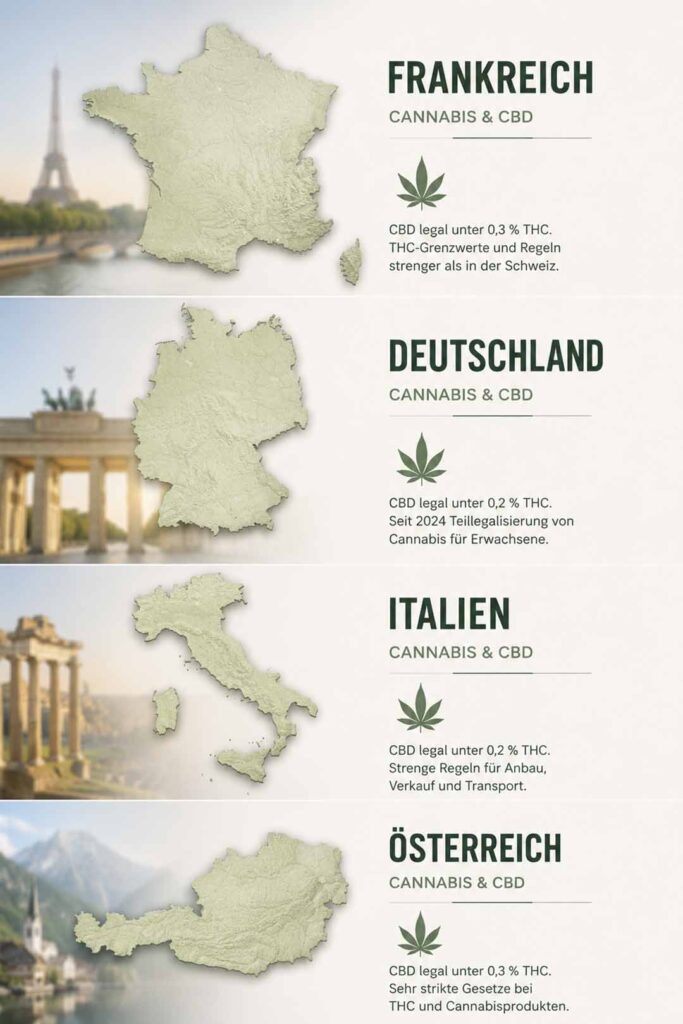
This is particularly important for travelers from Switzerland: Switzerland’s THC limit of less than 1 percent does not automatically apply in the EU. Therefore, you should not simply bring Swiss CBD flowers or hash products with you just because they are legal at home.
Germany
Germany has changed its cannabis regulations since 2024. However, this does not mean that travelers from Switzerland are allowed to import cannabis or CBD products at will. In particular, importation, product type, origin, and THC content remain sensitive issues. Therefore, when it comes to CBD flowers and CBD hash, do not bring them along without careful verification.
France
France has lifted its ban on CBD flowers and leaves containing less than 0.3 percent THC following a decision by the Conseil d’État. Nevertheless, travelers should not automatically assume that every Swiss product will be acceptable without issue. The THC content, the type of product, and the context in which it is used remain important factors.
Austria
In Austria, the THC limit for low-THC hemp is often set at 0.3 percent. However, product categories, advertising, and classification may be handled differently. For vacationers, the most important things to keep in mind are: clearly label the product, check the rules of your destination country, and do not bring Swiss 1-percent products with you without first verifying the regulations.
Italy
Italy has debated its CBD and “cannabis light” regulations on several occasions in recent years and has, in some cases, tightened them. This creates uncertainty for travelers. You should be especially careful not to bring flowers, resin, or other visible cannabis products with you.
CBD When Traveling Outside Europe: It’s Best to Be Extra Careful
Outside of Europe, the rules can be significantly stricter. In some countries, cannabis products can result in severe penalties, even if they contain only trace amounts of THC. This is especially true when traveling to Asia, the Middle East, or countries with strict drug policies.
Thailand shows just how quickly the situation can change. Following a period of liberalization, the country has once again placed greater emphasis on medical use of cannabis since 2025. In addition, separate rules apply there for public use, vapes, and cannabis products.
For long-distance travel, the safest advice is: Only bring CBD products with you if you have checked the current legal situation in your destination country, any transit countries, and with the airline. If in doubt, leave the product at home.
Medical cannabis while traveling is a special case
Medical cannabis does not belong in the same section as over-the-counter CBD products. Anyone carrying a medically prescribed cannabis medication must follow different rules.
For travel within the Schengen Area, Swissmedic requires a certificate for medications containing controlled substances. In addition, the amount carried may generally not exceed a 30-day supply. When traveling outside the Schengen Area, additional embassy or country-specific regulations may apply.
You can find more information about the legal situation in Switzerland on our blog, Medical Cannabis Switzerland.
Checklist Before Vacation
Before you take CBD with you on a trip, check these points:
- Is CBD allowed in the destination country?
- What is the THC limit there?
- Are flowers, hash, vapes, cosmetics, or liquid products subject to different regulations?
- Are you traveling through transit countries with stricter rules?
- Is the product in its original packaging and clearly labeled?
- Are there any lab results or product information available?
- Does this product comply with carry-on baggage rules?
- Do you drive a car, and are there any special traffic rules that apply?
- Is this an over-the-counter product or a prescription medication?
- If there are several points you’re not sure about, it’s better to err on the side of caution than to take a risk.
Conclusion: Traveling with CBD requires preparation
CBD while traveling is a common issue where Swiss daily life and foreign legal situations can diverge. What is legally available in Bern, Zurich, Basel, or Solothurn is not necessarily permitted abroad.
You should be especially careful with CBD flowers, CBD hash, vapes, e-liquids, and products with unclear labeling. Personal care products often seem less sensitive, but they also require appropriate packaging and must comply with the regulations of the destination country.
As a Swiss CBD company, we want to do more than just offer products—we also want to provide guidance. Herba di Berna is rooted in the heart of Switzerland, in the wonderful city of Bern, and thinks on a national scale. That’s why we focus on clear information, transparent product details, and fast delivery to every canton. But when it comes to vacations, the rule still applies: Check first, then pack.
That depends on the destination country, the transit country, the product, and the THC content. Swiss CBD products are not automatically permitted abroad because many countries have lower THC limits or different product regulations.
No. While the EU does influence certain regulatory frameworks, individual countries have different regulations regarding CBD products, flowers, food, cosmetics, and vapes. That’s why it’s worth checking the latest regulations before every trip.
If you can’t clearly determine the legal status, don’t bring the product with you. This applies especially to flower, hash, vapes, and products with unclear labeling.
CBD products may be carried in carry-on luggage only if they are legally permitted in the destination country and comply with security regulations. Liquid or cream-based products must generally be carried in containers of up to 100 milliliters.
There’s no one-size-fits-all answer. CBD flowers are particularly tricky because they can look and smell like cannabis that contains THC. Always check the rules of your destination country before you travel.
Medical cannabis requires its own assessment. In the Schengen Area, a doctor’s prescription is generally required for medications containing controlled substances. The quantity may not normally exceed a 30-day supply.
List of sources
Federal Office of Public Health: Legislation on Hemp and Cannabis Products
Swissmedic: Traveling with Medications Containing Narcotics
Swissmedic: The Schengen Area and Medications Containing Narcotics
Your Europe: Luggage restrictions and liquids in carry-on luggage
EFSA: Provisional safe level for cannabidiol as a novel food
Conseil d’État: CBD, annulment of the order prohibiting cannabis flowers and leaves
German Federal Ministry of Health: Frequently asked questions on the Cannabis Act
Royal Thai Embassy Copenhagen: Latest update on cannabis regulations in Thailand