Ordered by 15:00, shipped the same day! Free shipping starting CHF.- 80!


 B2b registration
  Client login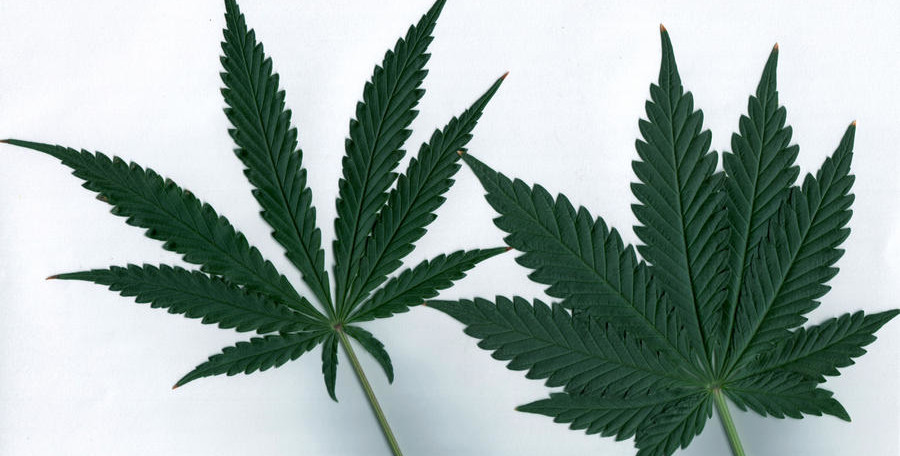
Sativa vs. Indica is one of the best-known classifications in the cannabis world. Many people associate Sativa with stimulating strains and Indica with relaxing strains. But it’s not that simple. The terms originally referred primarily to botanical differences. They say very little about cannabinoids, terpenes, or the actual quality of a flower.
This distinction is particularly important when it comes to CBD flowers. When choosing a strain, you shouldn’t just look at whether it’s labeled as Sativa, Indica, or Hybrid. More meaningful factors include origin, cultivation method, freshness, aroma, lab results, and the interplay of cannabinoids and terpenes.
In this post, we explain the difference between Sativa and Indica, highlight the limitations of the traditional classification, and discuss what you should really look for when buying CBD flowers in Switzerland.
Cannabis sativa and its typical characteristics
Cannabis sativa is traditionally associated with warmer regions, longer flowering periods, and taller growth. The plants can grow slender, develop longer spacing between side shoots, and have narrow leaflets.
These characteristics can certainly be relevant for cultivation. After all, plant height, space requirements, light distribution, and flowering time all influence the planning and care of a cannabis crop.
In the retail market, Sativa is often associated with a fresh, lively, or more energizing profile. However, such descriptions are primarily based on personal experience and marketing. They do not guarantee how a particular product will be perceived.
When it comes to CBD flowers, a sativa-dominant strain can have an interesting aroma. However, the specific profile of the flower remains the deciding factor. Two strains labeled as sativa can differ significantly in terms of scent, terpenes, flower structure, and lab results.
Sativa vs. Indica: The Difference Explained in a Nutshell
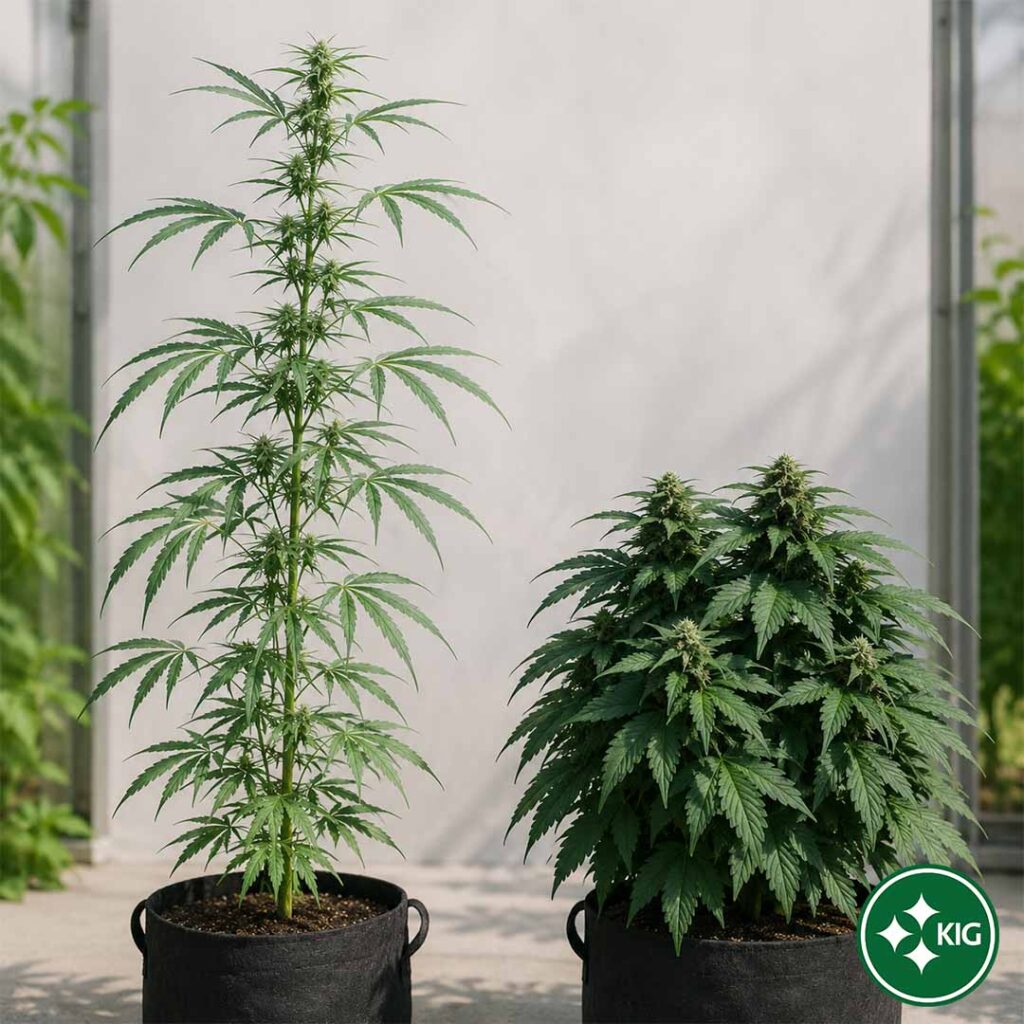
The classic Sativa vs. Indica distinction primarily describes the appearance and growth of the cannabis plant. Cannabis Sativa is usually described as tall, slender, and with relatively long leaves. Cannabis Indica, on the other hand, is considered more compact, bushy, and with broader leaves.
The growth patterns of the plants are also often classified differently. Sativa plants tend to grow taller and often take longer to reach harvest. Indica plants, on the other hand, usually remain shorter and often develop more quickly. However, these characteristics serve only as a rough guide.
The reason for this is simple: Most modern cannabis strains are hybrids. They contain genetic influences from various breeding lines. As a result, it is extremely rare today for a strain to be purely Sativa or purely Indica.
For consumers, therefore, the variety label is less informative than many product descriptions might suggest.
Cannabis Indica and Its Typical Characteristics
Cannabis Indica is traditionally described as a more compact and bushy plant. Its leaves often appear wider, while the plants generally remain shorter. The flowering time is also reported to be shorter for many Indica strains.
In the market, Indica is often associated with earthy, spicy, or heavy flavor profiles. There is also a widespread belief that Indica is generally calming. However, there is no reliable guarantee of this either.
Modern hybrids significantly blur the lines between Sativa and Indica. That’s why a high-quality CBD flower shouldn’t be chosen based solely on its “Indica” label.
More meaningful factors include high-quality craftsmanship, a natural aroma, transparent lab results, and a product description that provides more information than simple categorizations by variety.
Sativa is stimulating and Indica is calming—is that really true?
The well-known rule of thumb is: Sativa for the day, Indica for the evening. Sativa is often associated with a more energizing effect, while Indica is associated with a calmer one.
For certain varieties, such descriptions may well correspond to personal experiences. However, they are not suitable as a reliable rule. Modern cannabis strains are often complex hybrids, and a strain name alone says little about the actual chemical profile of a flower.
More significant are the cannabinoids present, the terpene profile, and their respective concentrations. In addition, people can react differently to the same strain.
Quality and processing also play a role. Harvest time, drying, storage, and freshness, for example, influence the aroma and the resulting terpene profile. A carefully processed flower can therefore have a much more distinct profile, regardless of whether it is classified as Sativa, Indica, or a hybrid.
Sativa and Indica can therefore serve as a starting point. However, for a more accurate assessment, cannabinoid levels, terpenes, and the quality of the flower are much more informative.
Why Sativa and Indica Often Fall Short Today
The traditional classification seems straightforward, but it greatly oversimplifies the diversity of the cannabis plant. Genetic origin, breeding lines, and chemical composition cannot always be reliably reflected by a “Sativa” or “Indica” label.
Modern variety names and hybrid designations, in particular, do not clearly reflect the characteristics that a plant actually possesses. Two products with the same variety name may differ depending on breeding, cultivation, and processing.
That doesn’t mean the terms are completely useless. They can provide a general description of how a plant grows or which breeding line it comes from. However, they are not sufficient for evaluating finished CBD flowers.
Anyone who wants to compare CBD flowers should therefore take a closer look. Cannabinoids, terpenes, cultivation methods, freshness, drying, and lab analysis provide much more information than simply asking: Sativa or Indica?
However, for many consumers , the smell, texture, and immediate impression of the flower are just as important. That’s exactly why we at Herba di Berna, the CBD specialty store in Bern, focus on personalized advice. Our customers can try the various Order CBD flowers or come in to see, smell, and compare them side by side. This often makes it easier to assess the individual aroma profile than relying solely on strain names or product descriptions.
Chemotypes Instead of Outdated Variety Categories
A more scientifically sound classification is based on the chemical composition of a cannabis plant. This classification is referred to as “chemotypes.”
A chemotype describes which cannabinoids are primarily present in a plant. To put it simply, strains can be categorized, for example, into THC-dominant, mixed, and CBD-dominant profiles.
This classification is also helpful when it comes to CBD flowers. A CBD-dominant strain can exhibit both typical Sativa and typical Indica characteristics. However, leaf shape, growth habit, or the terms “Sativa” or “Indica” do not reliably predict the CBD content or the terpene profile of the flower.
When it comes to actually evaluating a CBD flower, therefore, the chemical composition, the terpene profile, and the specific quality of the product are more meaningful than the botanical classification alone.
Chemotypes do not replace all quality characteristics. However, they help to evaluate a plant more objectively than a simple variety label.
Terpenes and cannabinoids are more meaningful
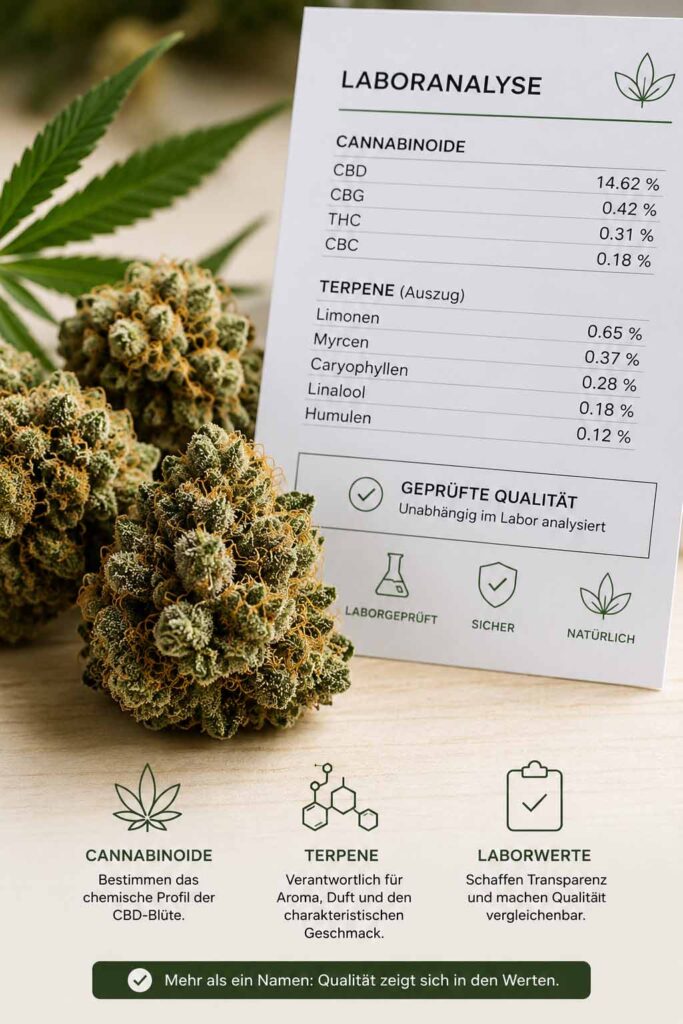
Cannabis contains numerous different plant compounds. Cannabinoids such as CBD, THC, CBG, and CBC are particularly well known. In addition, there are terpenes, which define the flavor and characteristic aroma of a strain.
Terpenes aren’t found only in hemp. Citrus fruits, herbs, flowers, and conifers also contain these aromatic compounds. In cannabis, they can be responsible for fruity, lemony, earthy, spicy, or floral aromas.
When describing CBD flowers, the terpene profile is often more informative than a “Sativa” or “Indica” label. It explains why two flowers that look similar can smell completely different.
In our knowledge blog on cannabis terpenes, we explain in detail which compounds are found in cannabis and why strains develop so differently.
In addition, cannabinoid levels are important. A reputable supplier should clearly state the CBD and THC content. Lab results provide transparency and help you objectively compare different strains.
Sativa, Indica, or Hybrid CBD Flowers
When it comes to modern CBD flowers, you’ll often come across terms like “sativa-dominant,” “indica-dominant,” or “hybrid.” These descriptions can serve as a starting point, but they shouldn’t be the sole factor in your decision.
A hybrid can be just as interesting as a strain that is heavily sativa-dominant or indica-dominant. The key factor is whether the overall profile matches the desired quality and preferred aroma.
Many Swiss CBD strains are specifically bred for stable cannabinoid levels, interesting terpene profiles, and compliance with the legal THC limit. As a result, laboratory analysis, cultivation methods, and processing have become more important than traditional strain classifications.
If you’re looking to compare different indoor, greenhouse, and outdoor strains, Herba di Berna offers a carefully curated selection of CBD flowers for sale in Switzerland.
Classifying Indoor, Greenhouse, and Outdoor Correctly
In addition to Sativa and Indica, the growing method plays an important role. Indoor, greenhouse, and outdoor buds can differ significantly in appearance, texture, aroma, and price.
Indoor flowers are grown under controlled conditions. Light, climate, and humidity can be precisely regulated. This often results in compact and visually very uniform flowers.
Greenhouse flowers combine natural sunlight with a protected growing environment. They can offer an interesting balance between controlled quality and natural development.
Outdoor flowers, on the other hand, grow in the open air. Wind, weather, soil, and sunlight shape their natural character. They sometimes look a bit more rustic, but can have a robust and authentic flavor profile.
None of these growing methods is automatically better. The right choice depends on your own expectations regarding appearance, flavor, and price.
You can find out more about growing methods, soil, fertilizer, seeds, cuttings, and how to grow healthy hemp plants in our CBD Growing category.
Swiss Classification of CBD Flowers and THC
Switzerland has a unique legal framework regarding low-THC cannabis. Cannabis flowers containing less than 1 percent THC may be legally sold and purchased, provided that the other requirements for the respective product category are met.
High-quality CBD flowers should be grown using clean methods, dried gently, stored properly, and labeled transparently. In addition, sellers should not make unrealistic claims about their effectiveness.
Herba di Berna is a Swiss startup with a retail store in Bern and an online shop serving customers throughout Switzerland. Our CBD flowers are carefully selected and discreetly delivered to every canton.
How can you tell if CBD flowers are high-quality?
When comparing CBD flowers, it’s worth looking at several quality characteristics. The “Sativa” or “Indica” label is only a small part of the picture.
Key features include:
- Clear information on CBD and THC content
- a natural and fresh aroma
- visible trichomes
- an appropriate residual moisture content
- Clean flowers with no musty or unusual odors
- Transparent information on origin and cultivation
- Proper packaging and storage
Price alone isn’t the only factor that determines quality, either. A high-quality outdoor flower can have excellent characteristics, even though it looks different from a compact indoor flower.
If you want to compare different products, you should therefore always look at the big picture.
Conclusion: A New Understanding of Sativa vs. Indica
The Sativa vs. Indica distinction sounds simple at first, but the reality is much more complex. Modern cannabis strains are almost always hybrids. That’s why the quality or profile of a CBD flower cannot be reliably determined from the strain label.
When it comes to CBD flowers, what matters most are clear lab results, a natural terpene profile, high-quality processing, and transparent sourcing. In Switzerland, the THC limit of less than 1 percent also plays a key role.
If you want to choose CBD flowers based on quality rather than just their name, Herba di Berna offers carefully selected strains and clear product information. Orders are shipped quickly and discreetly from Bern to all parts of Switzerland.
If you’re looking for more CBD products or want to learn more about CBD hemp oil, you’ll find everything you need here. Just stop by our CBD online store and conveniently order CBD for delivery anywhere in Switzerland.
FAQ zu Sativa vs. Indica
Was ist der wichtigste Unterschied zwischen Sativa und Indica?
The classic distinction lies primarily in plant growth. Sativa is usually described as taller and slimmer, while Indica is generally described as more compact and bushy. However, when evaluating finished CBD flowers, cannabinoids, terpenes, and lab results are more important.
Sind CBD-Blüten Sativa oder Indica?
CBD flowers can be sativa-dominant, indica-dominant, or hybrid. At Herba di Berna, over 90% of our flower varieties are hybrids today. This clearly illustrates how much the traditional boundaries between sativa and indica have blurred in modern breeding. Therefore, what matters most are not rigid categorizations but rather aroma, texture, freshness, processing, and verifiable CBD and THC levels.
Wirkt Sativa immer anregend und Indica immer beruhigend?
No. That classification is too simplistic. Many claims are based on anecdotal evidence and marketing. Modern strains are often hybrids, which is why the specific cannabinoid and terpene profile provides more information.
Warum sind Terpene bei CBD-Blüten wichtig?
Terpenes define a strain’s scent and flavor profile. They help distinguish between different CBD flowers more precisely and often provide more practical information than a simple “Sativa” or “Indica” label.
Worauf sollte ich bei CBD-Blüten achten?
Pay attention to transparent lab results, origin, freshness, and processing. But even more important is your personal impression: If you like the smell and feel of a flower, there’s a good chance that the strain is right for you. That’s why it’s worth visiting our specialty store in Bern to see and smell different CBD flowers for yourself.
List of sources
- Watts, S. et al. (2021): Cannabis labeling is associated with genetic variation in terpene synthase genes. Nature Plants.
About the study in *Nature* - Sawler, J. et al. (2015): The Genetic Structure of Marijuana and Hemp. PLOS ONE.
About the study in PLOS ONE - Murovec, J. et al. (2022): Analysis of Morphological Traits, Cannabinoid Profiles, THCAS Gene Sequences, and Photosynthesis in Wide- and Narrow-Leaflet High-Cannabidiol Breeding Populations of Medical Cannabis. Frontiers in Plant Science.
About the study in *Frontiers in Plant Science* - de Meijer, E. P. M. et al. (2003): The inheritance of chemical phenotype in Cannabis sativa L. Genetics.
View the study on PubMed - Zandkarimi, F. et al. (2023): Comparison of the Cannabinoid and Terpene Profiles in Commercial Cannabis from Natural and Artificial Cultivation. *Molecules*.
View the study on PubMed Central - Federal Office of Public Health (FOPH): Current Legal Status of Hemp and Cannabis Products in Switzerland.
Official information from the FOPH