Ordered by 15:00, shipped the same day! Free shipping starting CHF.- 80!



 B2b registration
  Client login
The sun is blazing, the pot is getting hot, and by the afternoon, the leaves are suddenly drooping. Especially during a heat wave, a question quickly arises when growing outdoors: Does my cannabis plant simply need more water right now, or might getting less direct sunlight for a while actually be better?
Heat stress in cannabis isn’t caused by high temperatures alone. The combination of intense sunlight, dry soil, wind, and a heated root zone is particularly problematic. Potted cannabis plants, young plants, and freshly planted cuttings are especially susceptible to this.
In this guide, you’ll learn how to water cannabis properly in hot weather, protect the soil with mulch, recognize overwatering, and find out when partial shade can be beneficial in the height of summer.
You can find the right soil, fertilizer, planters, and other essentials for your growing project in our CBD Growing category.
Cannabis Heat Stress: A Brief Explanation
At high temperatures, a plant releases more water into the environment through its leaves. At the same time, the roots must be able to supply sufficient moisture.
When high temperatures are combined with dry air, wind, or intense sunlight, the stress on the plants increases. The root zone can become particularly problematic. A dark plant pot on a sunny patio heats up much faster than deep garden soil.
Scientific studies on cannabis also show that elevated temperatures can affect plant development. In a controlled study, medical cannabis plants were cultivated at day/night temperatures of 25/21 °C and 31/27 °C, respectively. The higher temperature reduced the total cannabinoid concentration, while the effects on flower dry weight depended on the specific strain studied.
However, that does not mean that 31 °C is a universal limit for cannabis. Genetics, root space, soil moisture, humidity, and location all work together to influence how a plant responds to heat.
How can you tell if cannabis is experiencing heat stress?
When the leaves droop on hot afternoons, that’s a clear warning sign. Expert advice from the production side: David Spring, production manager at Herba di Berna, emphasizes that water balance is the be-all and end-all: “Even if a plant appears to recover overnight after experiencing drought stress, invisible damage has already been caused by the dry spell. This can result in yield losses or quality defects—it is absolutely essential to avoid further drought stress.”
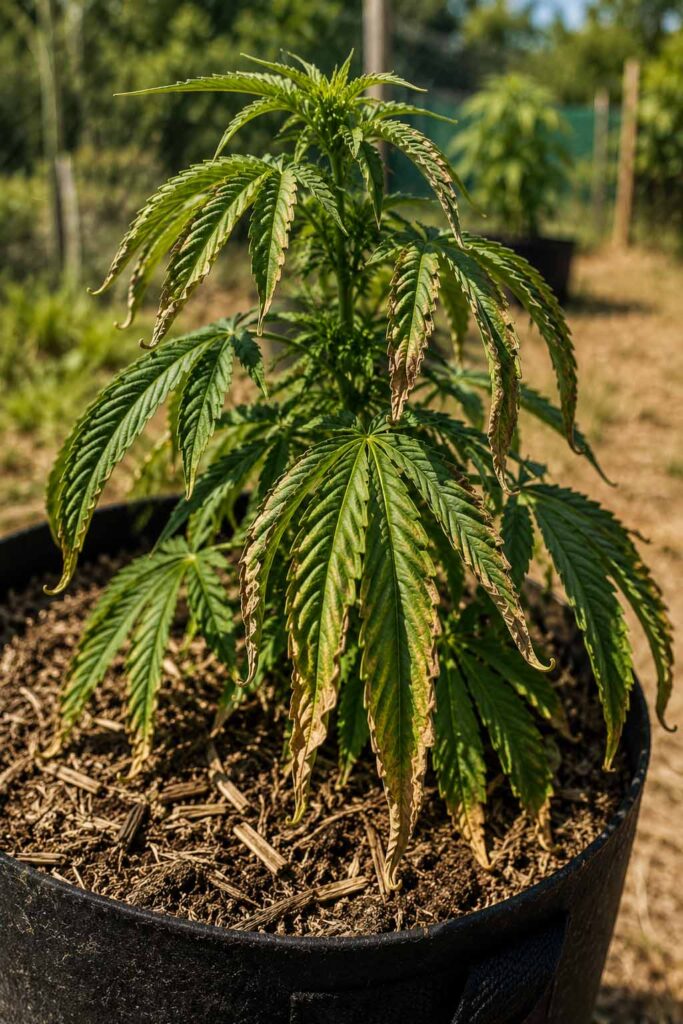
Possible signs of heat stress in cannabis include:
- leaves that droop heavily
- curled or arched leaf edges
- dry or discolored patches on the leaves
- soil that dries out unusually quickly
- planters that get very hot
- slowed growth
- Lack of rest in the evening or morning
General plant care guidelines also list wilting, leaf curling, and dry or scorched spots as possible signs of heat stress.
That’s why one of the most important rules in this post is:
Check the soil first—don’t automatically reach for the watering can.
At what temperature does cannabis get too hot?
There is no universal limit. Air temperature alone does not provide enough information about the actual stress a plant is experiencing.
A large cannabis plant growing in deep, sufficiently moist garden soil can cope with a hot summer day differently than the same strain growing in a small black pot on a south-facing stone surface.
Among other things, the following are crucial:
- Duration of the Heat Wave
- direct sunlight
- Humidity
- Wind
- Genetics
- Plant Age
- Pot size
- Soil moisture
- Temperature in the root zone
That is why the plant’s actual response is more important than a fixed temperature value.
We explain in more detail how light, climate, root space, and other growth factors generally interact in the article “Increasing Cannabis Yields: Understanding Light, Soil, and Growth.”
How to Water Cannabis Properly in Hot Weather
During a heat wave, water requirements often increase. However, that doesn’t mean cannabis plants should automatically be hosed down haphazardly every morning. Production Manager David Spring shares this insight from his experience: “Beginners, in particular, tend to give potted plants a thorough hosing every morning. But that puts additional stress on the plant.”
The Coaster Principle Instead of Constant Rinsing
Instead, Dave recommends using a saucer to create a controlled water reservoir for the day. Add enough water to ensure the plant stays well-hydrated throughout the day. It’s important, however, that the saucer empties completely at least once during the day. This prevents harmful standing water (waterlogging) while protecting the plant from drought stress.
Water early in the morning
Early morning is the ideal time to water your plants. The soil and roots are still cool, and the plant can absorb moisture before the midday heat sets in. However, if a plant is severely dried out in the afternoon, you shouldn’t stubbornly wait until the next morning.
The Earth decides, not the calendar
Stick a finger a few centimeters deep into the soil. If the soil is still cool and noticeably moist there, the plant usually doesn’t need water yet. For potted plants, the weight test is helpful: A dry pot feels considerably lighter than one that’s thoroughly moist.
Recognizing Dryness or Overwatering
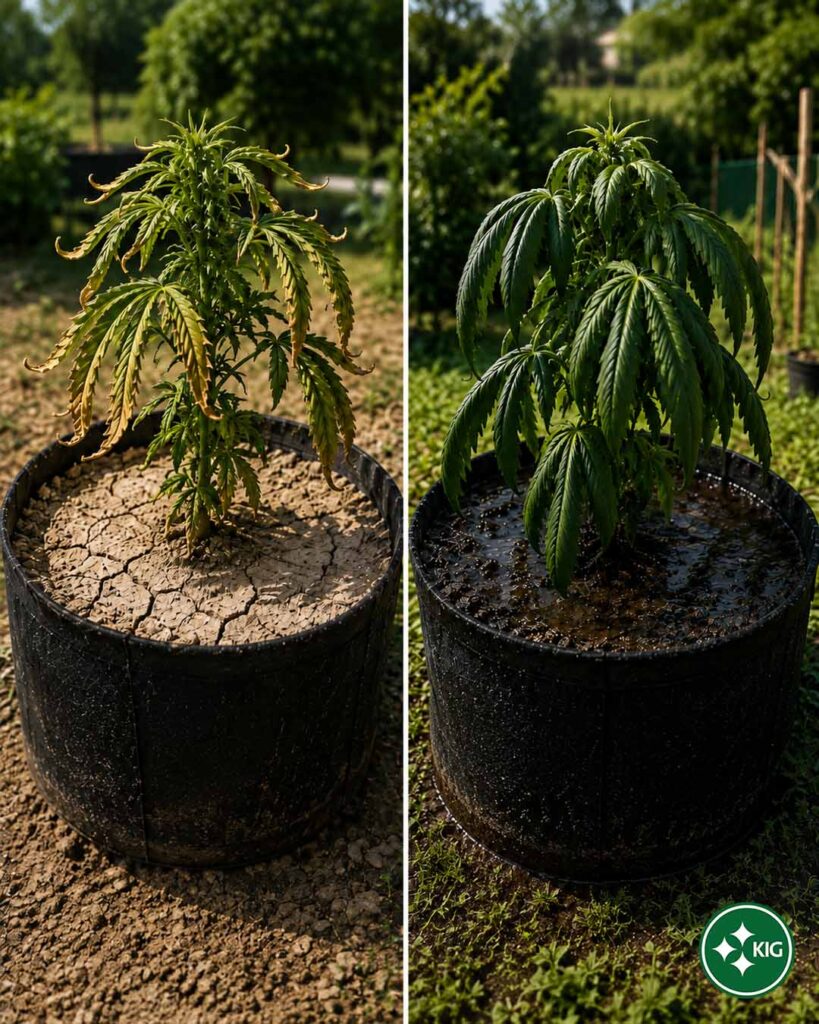
The most common misconception in the summer is this: If the leaves are drooping, the plant definitely needs water. It’s not that simple, though, because the symptoms can be misleading.
Signs of Water Shortage
Typical signs include a noticeably light pot, bone-dry soil (which often comes away from the edge), and leaves that appear limp. Since very dry soil often absorbs water poorly, you should water slowly in several stages in this case.
Signs of too much water
The pot feels heavy, the soil stays wet for a long time, water pools in the saucer—and yet the leaves are still drooping. Cannabis roots need oxygen. Soil that’s constantly wet suffocates the plant and isn’t a solution to heat stress.
Mulching Cannabis and Protecting the Soil from Heat
Mulching is one of the simplest and most effective measures to take during a prolonged heat wave.
An exposed soil surface is directly exposed to the sun and wind, causing water to evaporate more quickly and the upper root zone to heat up more rapidly.
A loose layer of mulch reduces evaporation and helps moderate temperature fluctuations in the soil. Oregon State University specifically recommends mulch as a protective measure during heat waves.
Examples of suitable materials include:
- Straw
- dry leaves
- dried grass clippings
- untreated wood chips
- Bark material
- Living Mulch (living groundcover)
Pro Tip from Dave (Production Manager): “Mulching with compost doesn’t make sense in extreme heat and should be avoided. Instead, living mulch—which naturally shades and protects the soil surface—should be at the top of your list when it comes to this topic.”
How thick should the layer of mulch be?
For coarse organic material, about 5 to 8 centimeters is a good general guideline. This is roughly equivalent to the two to three inches of organic mulch often recommended in gardening guides.
You should leave some space right next to the main trunk. A layer of mulch that stays damp shouldn’t accumulate there.
Don’t spread fresh grass clippings as a thick, wet layer. Let them dry out a bit first, and then spread them out loosely.
Does cannabis always have to be in direct sunlight?
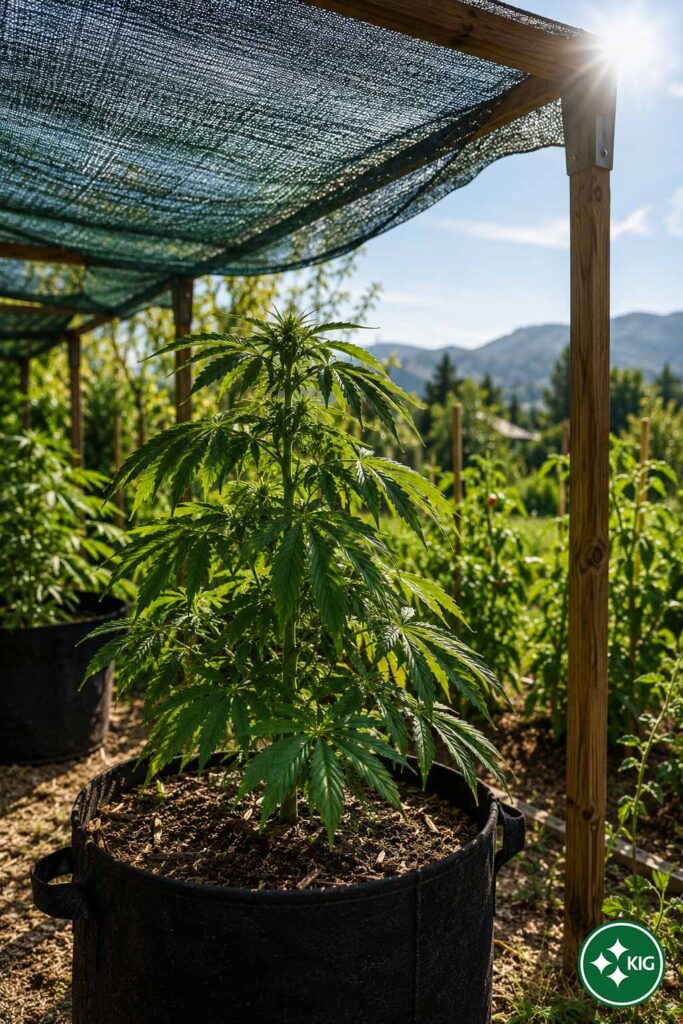
Cannabis needs a lot of light. However, that doesn’t mean a plant has to stand unprotected in the blazing sun from morning to night during an extreme heat wave.
The following combination is particularly unfavorable:
- intense afternoon sun
- dark plant pot
- heated stone floor
- reflective house wall
- dry wind
- low water reserve
In such situations, providing temporary partial shade during the hottest hours can be helpful.
A location that gets morning sun and offers some shelter from the strongest afternoon sun can help reduce the strain during extreme heat.
Horticultural experts also recommend that, during heat waves, potted plants that are particularly vulnerable be moved into the shade from time to time, and that sensitive plants be protected from the strongest sunlight.
The difference is important:
Temporary partial shade during a heat wave does not mean keeping cannabis in the shade all the time.
Take Extra Care to Protect Potted Cannabis Plants in Hot Weather
Outdoor cannabis grown in pots reacts more quickly to heat than a plant growing in deep garden soil. The volume of soil is limited and can retain less moisture.
Dark pots also absorb a lot of the sun’s heat.
Practical measures include:
Do not place the pot directly on hot concrete
Use a saucer to create a controlled water reservoir for the day (important: water enough so that the saucer empties completely once a day to prevent standing water and waterlogging)
Provide shade on the sides of the planter
A larger planter pot can also help shield the actual plant container from direct sunlight.
Pay special attention to young plants and cuttings
Young cannabis plants do not yet have a root system as well-developed as that of established plants. Their limited root mass can therefore dry out more quickly.
Newly planted seedlings should not be suddenly moved from sheltered conditions to full, intense summer sun. A gradual acclimatization and temporary protection during extreme afternoon heat may be advisable.
We explain the differences between these starting materials in detail in the article “Cannabis Seeds or Cuttings: The Regional Guide to Growing in Switzerland.”
For the current season, Herba di Berna also offers a selection of CBD cuttings grown in Switzerland. The current category features various rooted CBD clones for indoor and outdoor projects.
What should you avoid during a heat wave?
What should you avoid during a heat wave? A plant under heat stress doesn’t need to deal with several additional stresses at the same time. Therefore, avoid the following as much as possible:
- Standing water: The general warning about “wet soil” is misleading in the height of summer. Production Manager David Spring clarifies: “During a real heat wave, wet soil is always better than drought stress. The real problem is standing water.” So make sure the saucer is emptied once a day.
- frequent, small, shallow waterings
- Large-scale repotting campaigns
- severe pruning and aggressive defoliation
- Large amounts of fertilizer as supposed emergency aid
- dark pots placed directly on hot concrete
- complete permanent shade
Production Tip from David Spring: As an effective immediate measure during extreme heat, applying silicon is recommended. Whether through mineral-based products or organic formulations, silicon strengthens cell walls and noticeably improves the plant’s resistance to heat stress.
Cannabis Plant Is Wilting in the Heat: First Aid in 7 Steps
- Moisture Check: Check the soil a few centimeters deep with your finger.
- Weight Test: Lift the potted plants to estimate how much water is left.
- What to Do During Drought: Water lightly and thoroughly if the soil is loose.
- What to Do in Wet Conditions: If the pot feels heavy, don’t add any more water, and check the drainage holes.
- Check for heat buildup: See if the pot, the stone floor, or the wall of the house has become extremely hot.
- Adjust the location: If necessary, provide temporary partial shade during intense afternoon heat.
- Monitor its progress: Check the plant in the evening and the next morning to see if it has recovered.
Return to Normal Care After the Heat Wave
As temperatures drop, you should adjust your care routine accordingly.
A plant that needed daily watering during the heat may need significantly less water in cooler weather. So keep checking the soil and don’t automatically stick to the watering schedule you used during the heat wave.
You can gradually remove the temporary shading. Parts of the plant that have completely dried out can be carefully cut off later. You shouldn’t rush to remove leaves that are still mostly green.
I would also wait to apply a strong fertilizer until the plant appears stable again.
Conclusion: When it comes to growing cannabis in the summer, balance is key—not maximum sun exposure
Heat stress in cannabis plants can often be prevented by considering water, the root zone, and the growing location together.
Water as early and thoroughly as possible, but don’t keep the soil constantly wet. A loose layer of mulch helps retain moisture in the soil longer and mitigates extreme temperature fluctuations.
Temporary partial shade can be particularly beneficial for potted plants during periods of extreme afternoon heat. At the same time, you should avoid unnecessary repotting, heavy pruning, and excessive fertilization during a heat wave.
At Herba di Berna, you’ll find the right CBD growing products for your grow project. If you’d rather explore ready-made Swiss hemp products, you’ll also find our selection of CBD hemp, which can be quickly delivered online from Bern to anywhere in Switzerland.
You can get personalized advice at our CBD shop in Bern
Frequently Asked Questions (FAQ) about Cannabis Heat Stress
How often does a cannabis plant need to be watered during extreme heat stress?
There is no fixed watering schedule for cannabis in hot weather, as small pots dry out significantly faster than large containers or garden soil. Instead, regularly check the actual soil moisture and the weight of the pot to determine the exact water requirements.
What causes drooping cannabis leaves despite sufficiently moist soil?
Drooping leaves on cannabis do not necessarily indicate a lack of water but can be caused by overly wet soil, poor drainage, or heat stress in the root zone. Therefore, always check the exact soil conditions first before applying any additional watering measures.
How does a saucer help with the daily watering of cannabis in the summer?
During intense heat, production manager Dave recommends using a saucer as a water reservoir to consistently supply the cannabis plant throughout the day. However, this reservoir should be completely absorbed once a day to effectively prevent waterlogging and root rot.
Why can full sun cause heat stress in cannabis?
Although cannabis plants require a lot of light, intense afternoon sun combined with a heated pot and dry soil causes massive heat stress. During such extreme heat waves, temporary partial shade is highly recommended to protect the plant from burns and dehydration.
Which mulch material best protects cannabis plants from heat stress?
Materials such as straw, dry leaves, untreated wood chips, or a living undergrowth (living mulch) are ideal for heat protection. The mulch must always remain loose and should not touch the main stem directly, while fresh compost should be strictly avoided during extreme heat.
Why should you avoid repotting cannabis plants during an extreme heatwave?
Repotting during a heatwave should be strictly avoided because this process places massive strain on the root zone. Since the plant is already heavily occupied with regulating heat stress, you should definitely wait for milder temperatures to repot.
List of sources
- Holweg, M. M. S. F. et al. (2025): High air temperature reduces the yield of specialized metabolites in medical cannabis and has genotype-specific effects on inflorescence dry matter production. Environmental and Experimental Botany.
To the scientific study on ScienceDirect - Oregon State University Extension: Heat Waves in the Garden: How to Identify and Prevent Heat Stress in Plants.
Read the technical article from Oregon State University - University of Minnesota Extension: Keep gardens thriving during hot weather.
Read the University of Minnesota’s technical article - University of Minnesota Extension: Fertilizing and Watering Container Plants.
Go to the information on watering container plants