Ordered by 15:00, shipped the same day! Free shipping starting CHF.- 80!


 B2b registration
 Client login

CBD in sports is often associated with faster recovery, less muscle soreness, and improved performance. However, human research to date does not necessarily support such general claims. Some small studies provide interesting insights, while other studies find no benefit.
To get a realistic picture, we also need to distinguish between ingested CBD, cosmetic body care products, and various hemp products. This article explains what current studies say, the role that gels, ointments, and bath additives play, and what recreational and competitive athletes should keep in mind.
What is CBD, and why is it of interest to sports research?
Cannabidiol, or CBD for short, is a compound found in the hemp plant. Unlike THC, pure CBD does not produce the typical cannabis high. It is nonetheless biologically active and is being studied in relation to, among other things, pain perception, stress, and the body’s stress responses.
However, a potential mechanism of action does not necessarily prove practical benefits. Results from cell and animal experiments cannot be directly applied to humans during exercise. This requires controlled human studies that examine specific questions regarding performance or recovery.
The formulations also differ. Studies use precisely defined compositions and quantities. Commercially available CBD oil can differ significantly from these in terms of extract, accompanying substances, and intended use. Therefore, a study using a specific formulation does not automatically confirm the effectiveness of a retail product.
Does CBD Improve Athletic Performance?
A randomized, double-blind crossover study by Sahinovic and colleagues from 2025 examined 25 trained runners. On different occasions, each participant received a placebo, 50 milligrams, or 300 milligrams of CBD. This was followed by a long-distance endurance run and an exercise test to the point of exhaustion.
CBD did not improve endurance performance under these conditions. Heart rate, oxygen uptake, perceived exertion, and pain perception during the endurance run under study also showed no corresponding benefit. Taken together, the individual physiological changes did not result in any demonstrable improvement in performance.
The study does not answer every question about every sport or long-term use. However, it provides no reason to consider CBD a reliable endurance booster. Claims about increased strength, improved muscle growth, or greater motivation to exercise would also require appropriate evidence in each case.
Personal experiences may still vary. If someone finds it more enjoyable to exercise after a treatment, there could be various reasons for this. Expectations, how you feel that day, sleep, and the structure of your workout also influence the experience.
CBD in Sports, Recovery, and Muscle Soreness: What Do the Studies Show?
After an unusual or intense workout, many athletes are particularly interested in their recovery. Scientists examine various outcomes: subjective pain, muscle strength, flexibility, and blood markers. A change in a single measurement does not automatically mean that a person will be able to exercise again sooner overall.
Early Signs After Taking CBD
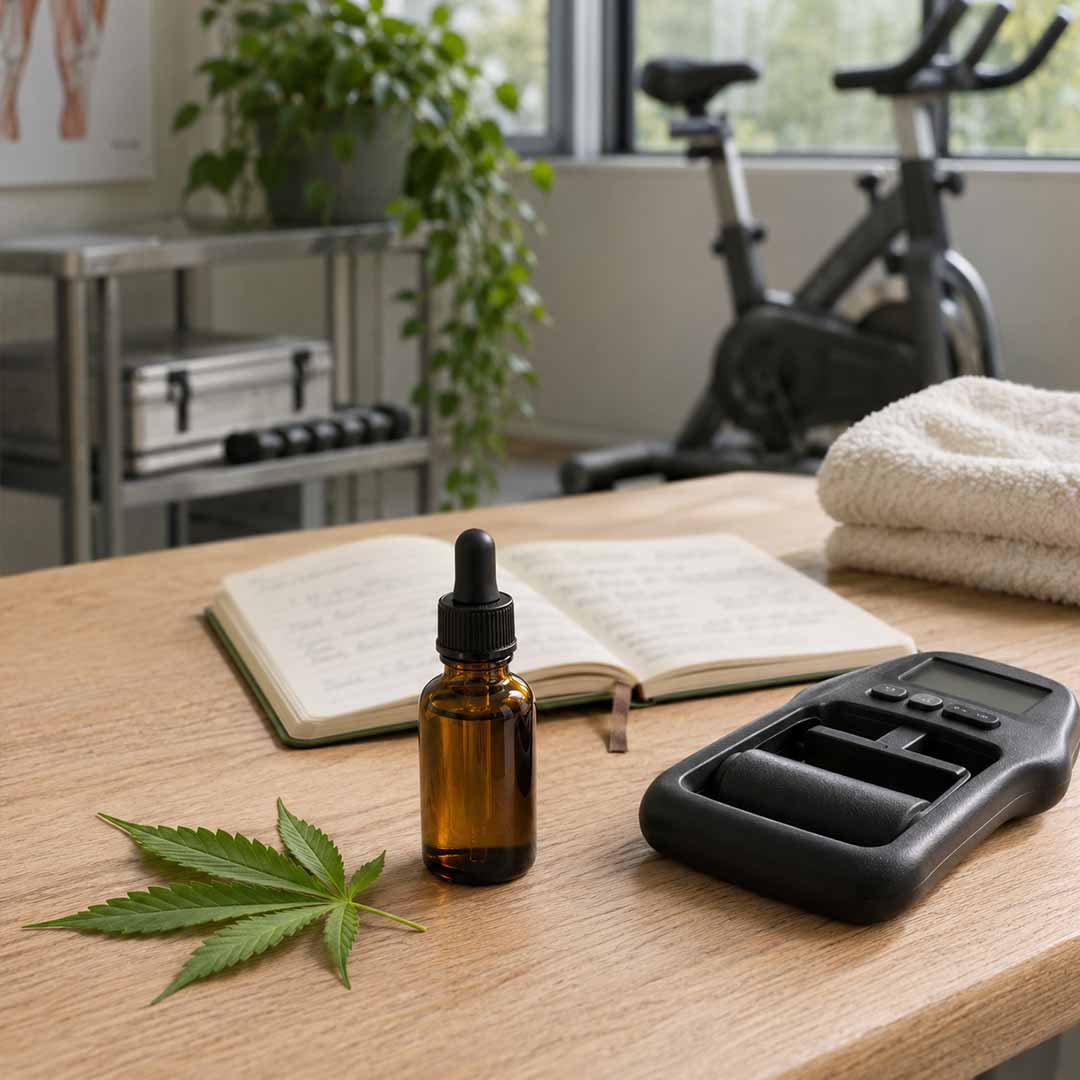
A randomized, placebo-controlled feasibility study by Stauffer and colleagues from 2026 involved 29 young adults. Over a period of 15 days, they received either a CBD-rich hemp extract or a placebo. During the study, a predetermined exercise protocol triggered discomfort in the thigh muscles.
The researchers observed evidence of reduced pain and functional limitations in the CBD group. However, the study was small and designed as a feasibility study. The authors believe that larger studies are needed to confirm the estimated effects.
These findings call for further research. They do not yet allow for a general recommendation regarding post-workout recovery. In addition, the preparation was administered sublingually; therefore, the findings do not automatically apply to cosmetic applications.
What were the findings of a study on CBD gel?
In 2026, Mendes and colleagues studied a topically applied CBD gel in 15 physically active participants. In a randomized, double-blind crossover trial, they compared it to a placebo gel following a muscle-straining jumping exercise.
No significant differences were found in muscle soreness or the blood marker for muscle damage that was examined. A single strength measurement was in favor of CBD. Overall, however, the authors concluded that the gel did not appear to accelerate the recovery of muscle function or reduce muscle soreness.
The study examined a specific formulation. It is not possible to use these findings to confirm the effects of all CBD gels or to conclusively evaluate any other formulation. However, general claims such as “CBD relieves muscle soreness” go beyond these results.
CBD oil for sports, flowers, and cosmetics are different product forms
In everyday conversation, people often refer to “CBD products” in general terms. This is too vague for an accurate classification. Plant material, extracts, and cosmetic formulations differ in their composition and application.
CBD flowers are plant material containing several natural components. A flower is therefore not the same as purified CBD from a controlled study. In particular, they may contain other cannabinoids, which is also relevant when assessing a potential doping risk.
Similarly, a cosmetic massage oil, an aromatic oil, and a medicinal CBD product are not interchangeable. What matters is the specific labeling and the intended use. The common term “CBD” does not make different products comparable in their applications.
Can CBD Reduce Stress in Sports?
Nervousness can arise before a competition or a challenging training session. That is why CBD is also associated with mental calm and concentration. However, it is important to distinguish between normal tension, persistent everyday stress, and anxiety disorders that require treatment.
The 2025 running study presented here showed no clear benefit in terms of mood or anxiety following exercise. While this does not answer all questions about the psychological effects of CBD, it does not allow for a blanket claim regarding its benefits for healthy athletes.
What are the possible risks and side effects?
CBD is biologically active and is not inherently free of side effects. When taken, it may cause drowsiness, gastrointestinal discomfort, and interactions with medications, among other things. Potential effects on the liver should also be taken into account.
These findings should not be applied indiscriminately to every cosmetic application. Conversely, “plant-based” does not automatically mean safe. Anyone taking medication or wishing to treat medical conditions with CBD should discuss this with a healthcare professional.
CBD and Doping: What Are the Rules for Competitive Athletes?
The 2026 WADA Prohibited List explicitly exempts cannabidiol from the ban on cannabinoids. Other natural and synthetic cannabinoids, including THC, are prohibited in competition. Therefore, a product containing CBD is not automatically safe in terms of doping controls.
Swiss Sport Integrity generally recommends that athletes avoid cannabis and CBD products. Terms such as “THC-free” or “broad spectrum” should therefore not be interpreted as a blanket guarantee of a negative doping test. Nor can a general withdrawal period be inferred from these terms.
Conclusion: CBD in sports requires a nuanced approach
CBD remains an interesting topic in sports research. However, the human studies presented so far do not provide a basis for guaranteed performance improvements or generally faster recovery. Positive findings from small-scale studies require further confirmation.
When it comes to cosmetic products, it makes sense to compare texture, ingredients, and skincare properties. These characteristics should be kept separate from therapeutic claims. For athletes, realistic expectations, a proper understanding of the product’s form, and—where applicable—anti-doping rules are crucial.
Frequently Asked Questions About CBD in Sports
Steigert CBD die sportliche Leistung?
There is currently insufficient evidence to support a reliable improvement in performance . The controlled running study presented here found no benefit in endurance performance under the conditions examined.
Was unterscheidet CBD-Kosmetik von Studienpräparaten?
Cosmetic products are used for external care and come in a variety of formulations. Studies examine precisely defined formulations, quantities, and applications. Their results do not automatically apply to commercially available cosmetics.
Ist CBD im Wettkampfsport erlaubt?
CBD itself is exempt under the 2026 WADA Prohibited List. Other cannabinoids remain prohibited in competition. Due to the possibility of contaminants, Swiss Sport Integrity recommends that athletes avoid cannabis and CBD products or use isolated substances.
Hilft CBD gegen Muskelkater?
At this time, this cannot be generally confirmed. Research findings are inconsistent; the gel study presented found no significant reduction in muscle soreness compared to a placebo.
Versorgt mineralisches Badesalz die Muskeln mit Magnesium?
The magnesium sulfate contained in this product does not provide a reliable source of magnesium through the skin. Therefore, no effect against muscle cramps should be inferred from this.
Sind Hanfsamenöl und CBD-Öl dasselbe?
No. Hemp seed oil is derived from seeds that naturally contain no cannabinoids. Extracts containing cannabinoids differ from hemp seed oil in both composition and legal classification. Traces of cannabinoids in seed products may result from contact with other parts of the plant.
Sources
Sahinovic et al. (2025): The Acute Effects of Cannabidiol on Physiological and Subjective Responses to Endurance Exercise: A Dose-Ranging Randomized Controlled Crossover Trial. Original Publication
Stauffer et al. (2026): Efficacy and Safety of Cannabidiol (CBD) in Reducing Pain and Functional Impairment Associated with Exercise-Induced Muscle Injury: A Randomized, Placebo-Controlled Feasibility Trial. Original Publication
Mendes et al. (2026): Topical application of cannabidiol for muscle recovery following exercise-induced muscle damage: a randomized, double-blind pilot study. Original Publication
U.S. Food and Drug Administration (accessed November 4, 2026): What You Need to Know About Products Containing Cannabis or Cannabis-Derived Compounds, Including CBD. Regulatory Information
World Anti-Doping Agency (effective January 1, 2026): The 2026 Prohibited List, Section S8. Prohibited Substances List
Swiss Sport Integrity (accessed November 4, 2026): Fact Sheet on Competitive Sports, section on Cannabis/CBD. Fact Sheet
Federal Office for Food Safety and Veterinary Affairs (accessed November 4, 2026): Cannabis, hemp extracts, and cannabinoids as food. Information from the authorities