Ordered by 15:00, shipped the same day! Free shipping starting CHF.- 80!



 B2b registration
  Client login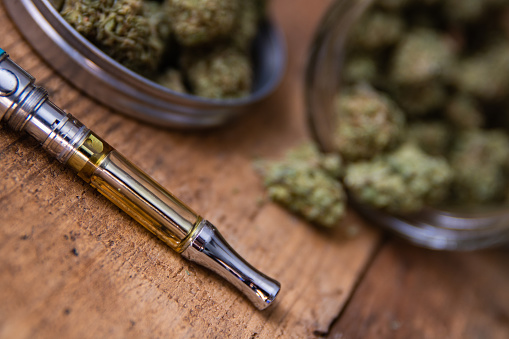
For many adult consumers, vaping CBD is an exciting alternative to the classic smoking of hemp flowers. Instead of burning plant material, vaporizing or vaping involves heating a suitable product until vapour is produced. However, this is where the most important distinction begins: Not every CBD product is suitable for vaping.
At Herba di Berna, we often see CBD liquids, CBD flowers and CBD oils being confused with each other in specialist stores. This can be problematic, as CBD oil should never be used in a vape pen or vaporizer. In this article, we explain what vaping CBD means, which products are suitable, what you should look out for in terms of temperature and quality and how to clearly classify the difference to our other CBD products.
Briefly explained: What does CBD vaping mean?
Vaping CBD means heating a suitable CBD product using a technical device and inhaling the resulting vapor. Depending on the product, this is done either with a vape pen for CBD liquids or with a dry herb vaporizer for dried CBD flowers.
Important: Vaping CBD is not the same as using CBD oil. CBD oils usually contain carrier oils such as hemp seed oil or MCT oil and are not made for heating in vape devices. Only products that are explicitly labeled as liquid, vape product or suitable for the respective vaporizer should be used for vaping.
Vaping CBD and bioavailability: why the form of intake is important
In science, bioavailability describes how much of a substance is actually available in the body. In the case of cannabinoids, the product form plays a major role. If a substance is inhaled, it reaches the bloodstream faster via the lungs than with many other absorption routes. Study overviews indicate an estimated bioavailability of around 31 percent for inhaled CBD, although the values can vary significantly depending on the product, device and application.
However, this does not mean that vaping CBD is automatically better. It just means that the form of intake works differently. The decisive factors for customers are therefore what they want to achieve with the product, what type of product they prefer and whether they want to inhale a product at all.
If you are generally interested in CBD oil, you will find suitable information on products that are used according to their declaration in our CBD oil category. For vaping itself, however, CBD liquids or CBD flowers in a suitable vaporizer are the right product groups.
Vaping CBD is not the same as smoking
A common misconception is to equate vaping with smoking. Smoking involves burning plant material. This produces smoke, ash and combustion products. When vaporizing, on the other hand, the material is heated in a controlled manner, ideally without combustion.
Expert reviews show that cannabis vaporizers can reduce certain levels of harmful substances compared to smoking. At the same time, however, the studies also emphasize that inhalation is fundamentally not risk-free and that further research remains necessary.
That’s why our approach at Herba di Berna is: don’t trivialize, but educate. If you would like to know more about why many people consider vaporizers to be an alternative to traditional smoking, our existing blog article Prefer vaping to smoking is a good place to start. The current article here deliberately remains the basic article on vaping CBD.
Which products are suitable for CBD vaping?
There are two main product groups relevant to CBD vaping: CBD liquids and CBD flowers. Both work differently and suit different needs.
CBD liquids for vape pens
CBD liquids are liquids that have been specially developed for suitable vape devices. They consist of a suitable carrier liquid and CBD or CBD-containing extract. The great advantage lies in their ease of use. Many devices are compact, discreet and can be used without much preparation.
Anyone interested in this type of product should pay attention to transparent ingredients, clear declarations and reputable origins. In our store, the Liquid category is relevant for this.
CBD flowers in the dry herb vaporizer
A second option is vaporizing CBD flowers. This requires a dry herb vaporizer with a herb chamber. The flowers are crushed, filled into the chamber and heated to a certain temperature.
The advantage: you use the natural plant profile of the flower, including cannabinoids, terpenes and other plant components. If you are looking for suitable products, you can find them in our CBD flowers category. For devices, grinders, cleaning and other accessories, the category CBD accessories.
Why CBD oil must not be vaped
CBD oil is not a vape liquid. This point is particularly important. CBD oils often contain carrier oils such as hemp seed oil or MCT oil. These oils are not intended to be heated and inhaled via a heating coil or vaporizer.
Heating unsuitable oils can produce undesirable substances. The device can also be damaged or clogged. Therefore, never use CBD oil in a vape pen, e-cigarette or vaporizer. Only use products that are expressly intended for vaping.
What temperature is suitable for CBD flowers in a vaporizer?
The right temperature depends on the device, the plant material and the desired vapor profile. Many vaporizers operate in the range between around 160 and 210 degrees Celsius. Lower temperatures often emphasize the aroma, while higher temperatures usually produce denser vapor.
You can use this as a simple guide:
160 to 175 degrees Celsius: gentle steam, more aromatic
180 to 195 degrees Celsius: balanced ratio of aroma and steam development
200 to 210 degrees Celsius: intense steam and stronger extraction of plant components
Terpenes play an important role in odor, taste and plant profile. You can find out more in our blog Cannabis terpenes explained. However, it is important to remember that higher is not automatically better. Too high a temperature can affect the taste and material.
Safety when vaping CBD: quality, ingredients and the black market
Quality is particularly important when vaping because the product is inhaled. International cases around EVALI, lung damage associated with certain vaping products, have shown how problematic untested products from informal sources can be. The CDC specifically linked the outbreak to THC-containing vaping products from informal sources and vitamin E acetate. Vitamin E acetate should not be used in vaping products.
For you, this means: don’t buy no-name products from dubious sources. Pay attention to transparent ingredients, traceable origins and reputable suppliers. With liquids in particular, it should be clear what is contained and for which device the product is intended.
Vaping CBD in Switzerland: what you should be aware of legally
In Switzerland, the legal classification of CBD products depends heavily on the intended purpose, composition and product category. Swissmedic points out that CBD products can fall under different legal areas depending on their use, such as chemicals law, therapeutic products law, food law or cosmetics law.
For foodstuffs, the following also applies: hemp extracts with cannabinoids are treated by the FSVO in the novel food context and require a corresponding authorization to be placed on the market as foodstuffs.
The Swiss Tobacco Products Act is also relevant for electronic cigarettes and similar products. The FOPH states that the sale of tobacco products and electronic cigarettes to minors is prohibited throughout Switzerland.
Conclusion: vaping CBD consciously and with the right product
Vaping CBD can be a quick and aromatic way for adult consumers to get to know CBD products. However, it is crucial that you make a clear distinction between the product groups. CBD liquids belong in suitable vape devices. CBD flowers belong in dry herb vaporizers. CBD oil never belongs in a vape device.
If you are interested in the topic, you will find suitable categories such as vape vaporizers, liquid, CBD flowers and CBD accessories at Herba di Berna. For specific device comparisons, it’s also worth checking out our Herba di Berna vaporizer test 2025 to find a setup that suits your everyday life, your quality standards and your personal approach to CBD.
Frequently Asked Questions (FAQ) about vaping CBD
Why must you never use conventional CBD oil for vaping CBD?
Anyone wanting to vape CBD must never use conventional CBD oil, as the carrier oils it contains can leave dangerous residues in the lungs when heated. Electronic vape devices strictly require special liquids or extracts that are explicitly designed for inhalation.
What is the exact difference between traditional smoking and vaping CBD?
Unlike traditional smoking, vaping CBD does not involve the harmful combustion of plant material, as the active ingredients are merely vaporized through heat. Although vaporizing releases significantly fewer pollutants as a result, inhaling vapor is not automatically entirely risk-free for the respiratory tract.
What is the optimal temperature for vaping CBD using natural hemp flowers?
To efficiently vape CBD flowers, a temperature between 160 and 210 degrees Celsius is usually recommended for a dry herb vaporizer. While lower temperatures gently highlight the complex terpene aroma, a higher heat setting ensures significantly denser vapor and a faster release of active ingredients.
Why does vaping CBD not cause an intoxicating high?
Purely vaping CBD does not get you high because cannabidiol (CBD), unlike THC, has no psychoactive, intoxicating effect on the brain. However, to ensure legal and safe consumption, it is essential to look for certified specialist retail quality with a lab-tested, legally permissible THC content.
What are the advantages of dry herb vaporizers compared to liquids when vaping CBD?
When vaping CBD, natural flowers in a dry herb vaporizer offer a more authentic plant profile since they completely avoid artificial carrier liquids like propylene glycol. Liquids, on the other hand, stand out due to their extremely simple everyday handling, meaning the choice heavily depends on the user’s personal preferences.
What should you look out for when buying CBD vape products?
Transparent ingredients, reputable origin, appropriate declaration, laboratory analyses and purchase from a trustworthy supplier are important. Avoid products from informal or untraceable sources.
List of sources
Millar, S. A. et al: Towards Better Delivery of Cannabidiol (CBD)
https://pmc.ncbi.nlm.nih.gov/articles/PMC7558665/
Millar, S. A. et al.: A Systematic Review on the Pharmacokinetics of Cannabidiol in Humans
https://www.frontiersin.org/journals/pharmacology/articles/10.3389/fphar.2018.01365/full
Chaiton, M. et al.: Are vaporizers a lower-risk alternative to smoking cannabis?
https://pmc.ncbi.nlm.nih.gov/articles/PMC8975973/
Loflin, M. et al.: No smoke, no fire: What the initial literature suggests regarding vaporized cannabis and respiratory risk
https://pmc.ncbi.nlm.nih.gov/articles/PMC4456813/
CDC: Characteristics of a Nationwide Outbreak of Lung Injury Associated with the Use of E-cigarette or Vaping Products
https://www.cdc.gov/mmwr/volumes/69/wr/mm6903e2.htm
Swissmedic: Products containing cannabidiol (CBD)
https://www.swissmedic.ch/swissmedic/de/home/news/mitteilungen/produkte-mit-cannabidiol–cbd—-ueberblick.html
BLV: Cannabis, Hemp Extracts, and Cannabinoids as Food
https://www.blv.admin.ch/blv/de/home/lebensmittel-und-ernaehrung/rechts-und-vollzugsgrundlagen/bewilligung-und-meldung/bewilligung/cannabis-cannabidiol.html
BAG: FAQs on the Implementation of the Tobacco Products Act
https://www.bag.admin.ch/de/faq-zur-umsetzung-des-tabakproduktegesetzes