Ordered by 15:00, shipped the same day! Free shipping starting CHF.- 80!



 B2b registration
  Client login
CBD and dementia are concerns for many family members, caregivers, and those affected by the condition. Especially when restlessness, sleep problems, anxiety, or behavioral changes place an additional strain on daily life, the question arises as to whether cannabidiol could play a supportive role.
CBD is a non-psychoactive cannabinoid found in the hemp plant and is being studied in relation to, among other things, the nervous system, the endocannabinoid system, and various associated symptoms. However, to date, there is insufficient evidence that CBD can stop, slow down, or cure dementia or Alzheimer’s disease.
This article explains what research on CBD and dementia actually shows so far, where its limitations lie, and why medical supervision remains particularly important for older adults.
In a Nutshell: What Does CBD Mean for Dementia?
When discussing CBD and dementia, the main question is whether cannabidiol could play a role in managing certain symptoms associated with dementia. These include, for example, restlessness, anxiety, irritability, sleep disturbances, nighttime activity, or behavioral changes.
It is precisely these so-called neuropsychiatric symptoms that can place a heavy burden on both those affected and their family members and caregivers. That is why researchers are investigating what impact cannabinoids might have on such symptoms.
However, the available data are limited at this time. Individual studies provide interesting insights but are not sufficient to recommend CBD as a proven treatment for dementia.
What is dementia, and why does it also affect family members?
Dementia is not a single clinical condition, but rather an umbrella term for various diseases characterized by a progressive decline in cognitive abilities. The best-known form is Alzheimer’s disease. Other forms include vascular dementia, Lewy body dementia, and frontotemporal dementia, among others.
According to the FOPH, an estimated 161,100 people in Switzerland live with dementia. Approximately 34,800 new cases are diagnosed each year. Alzheimer’s dementia is the most common form, accounting for about 60 percent of cases. These figures show how relevant this issue is for Switzerland, especially for families, long-term care facilities, and caregivers.
Dementia doesn’t just affect the person with the disease. Family members often take on many responsibilities: organization, companionship, care, conversations, doctor’s appointments, ensuring safety in daily life, and emotional support. When sleep problems, restlessness, or anxiety also arise, the burden often increases even further.
That is exactly why many people are looking for easy-to-understand information about CBD in relation to dementia. However, it is important to remember that any change in behavior should first be evaluated by a doctor, because pain, infections, medications, lack of sleep, or stress can trigger similar symptoms.
CBD, Alzheimer’s, and the Endocannabinoid System
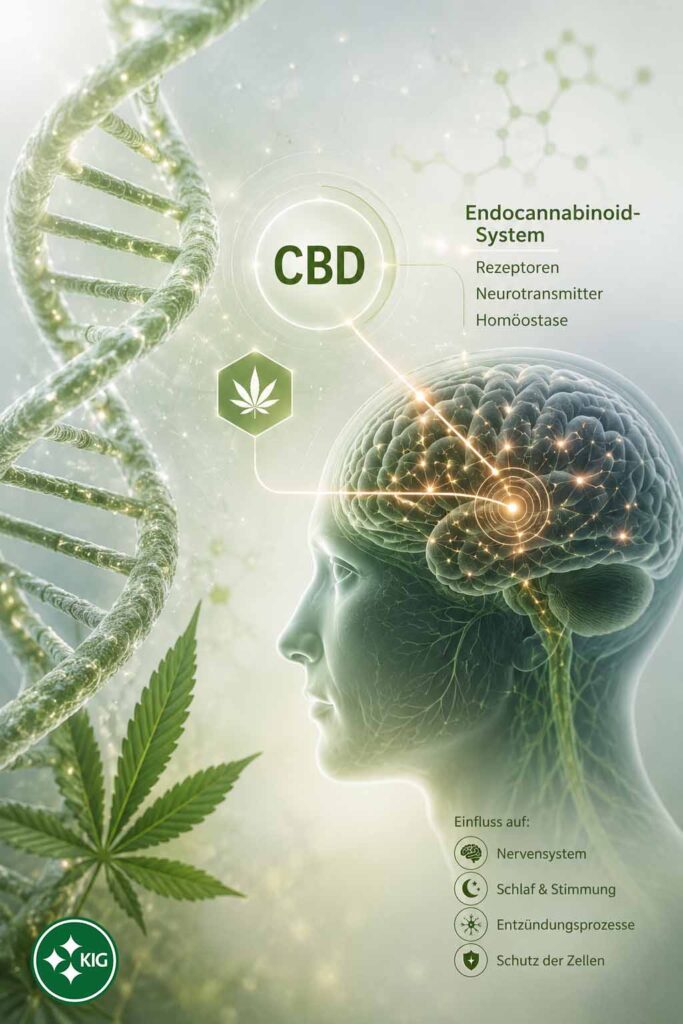
The endocannabinoid system is the body’s own regulatory system. It includes, among other things, cannabinoid receptors, endogenous cannabinoids, and enzymes. This system is associated with sleep, pain processing, appetite, mood, inflammatory processes, and stress responses.
CBD does not have an intoxicating effect like THC. Nor does it simply bind strongly to the same receptors; rather, it influences various signaling pathways more indirectly. This is precisely what makes CBD both exciting and complex for researchers.
When it comes to dementia and Alzheimer’s disease, scientists are primarily interested in whether cannabinoids might influence inflammatory processes in the brain, oxidative stress, nerve signals, restlessness, sleep, or behavioral symptoms. However, much of this evidence comes from laboratory research, animal models, or small clinical studies.
From a scientific standpoint, this means that the endocannabinoid system offers a fascinating biological approach. However, this does not yet constitute proof that CBD can treat dementia or slow the progression of Alzheimer’s—let alone cure it.
What does the research say about CBD and dementia?
Research on CBD for dementia is still in its early stages. There is preclinical evidence, small studies, and research on cannabis-based medications for behavioral symptoms. At the same time, there is a lack of large, independent, long-term human studies that would allow for clear recommendations.
The Alzheimer’s Society clearly summarizes the situation: There is no research proving that cannabis or CBD oil can stop, slow down, reverse, or prevent the diseases that cause dementia. This statement is central to our blog because it helps prevent false expectations.
The discussion regarding accompanying symptoms is more interesting. These include restlessness, agitation, anxiety, sleep problems, or caregiver burden. There is some evidence that cannabinoids might play a role here. However, the same principle applies here: results from small studies should not be taken as a basis for making general claims.
CBD for dementia therefore remains an area of ongoing research. There are some approaches, but no established treatment.
CBD for Restlessness, Anxiety, and Sleep Problems
Many family members turn to CBD for dementia because they are dealing with restlessness, depression, anxiety, or sleep problems. These symptoms can occur especially in the evening or at night. Some people with dementia become restless, react irritably, sleep poorly, or have trouble winding down—which is hardly surprising when you put yourself in their shoes.
Situations like these are stressful for everyone involved. However, they can have many causes: pain, the urge to urinate, infections, side effects of medications, feeling overwhelmed, changes in the environment, or a disrupted day-night rhythm. That is why it is important to first determine why the symptoms are occurring.
Studies have primarily examined cannabinoids in relation to such neuropsychiatric symptoms. The focus is not on a cure, but rather on potential effects on restlessness, sleep, and behavior. However, the data available to date are insufficient to recommend CBD as a miracle cure for dementia.
Anyone with a general interest in sleep and cannabinoids will find further context in our article “CBD and Dreams.” The same principle applies there: Sleep is complex, and CBD should not be presented as a simple solution to medical sleep problems.
CBD for Alzheimer’s: What Are the Limits?
Alzheimer’s is the most common form of dementia. It primarily affects memory, orientation, language, daily living skills, and personality. Many people hope that CBD or cannabis might have a protective effect in this context.
To date, there is insufficient evidence to support this. There is no evidence that CBD can prevent, halt, or reverse Alzheimer’s disease. Nor can memory loss, disorientation, or the progression of the disease be easily explained or influenced by CBD.
Research focuses on processes such as neuroinflammation, oxidative stress, amyloid deposits, and the protection of nerve cells, among other things. The aim is to investigate whether cannabinoids can influence certain biological mechanisms associated with neurodegenerative diseases.
This distinction is important for family members. There is room for hope, but it needs realistic limits. Anyone who wants to seek medical treatment for symptoms of dementia should always consult with healthcare professionals.

Safety, Side Effects, and Drug Interactions
Safety is especially important for people with dementia. Many of those affected are older, have multiple health conditions, or take various medications. This increases the risk of side effects and drug interactions.
CBD can interact with various medications and affect the concentration of their active ingredients. Therefore, especially in the case of older adults who are taking multiple medications, potential interactions should be evaluated by a doctor or pharmacist.
Possible side effects of pharmaceutical cannabidiol include fatigue or drowsiness, diarrhea, and a decreased appetite, among others. Especially for older adults, additional fatigue or a sedative effect can be problematic in daily life.
Products containing THC are not automatically suitable for people with dementia. THC can affect perception, orientation, circulation, and mental stability. Particular caution is needed, especially in cases of confusion, hallucinations, or significant behavioral changes.
Therefore, CBD or cannabis should never be tried for dementia without a doctor’s guidance.
Medical Cannabis in Switzerland: What’s Important?
In Switzerland, the ban on cannabis for medical purposes was lifted in August 2022. This has made it easier to access cannabis-based medicines. Since then, doctors have been able to prescribe cannabis-based medicines without needing a special exemption from the FOPH.
Over-the-counter CBD products available in stores are intended for a different purpose and may not be advertised as medicines. For Herba di Berna, this distinction is important. We provide information on research and hemp-related knowledge.
CBD Products and Dementia: Why We Remain Cautious
Many people search online for CBD hash or CBD cosmetics because they want to do something good for their loved ones. This motivation is understandable. Nevertheless, caution is especially important when it comes to dementia.
Dementia is a serious neurological disorder. Behavioral changes can have many causes and should be evaluated by a healthcare professional. CBD products should not be considered a substitute for diagnosis, care planning, or medical treatment.
Anyone interested in learning more about CBD hemp in general—regardless of medical topics—can find additional information about CBD oil and hemp at Herba di Berna, the Bern CBD shop.
When should you seek medical help?
In cases of dementia, new or worsening symptoms should always be taken seriously. This is especially true if restlessness, anxiety, sleep problems, or confusion suddenly appear or worsen significantly.
A medical evaluation is especially important in cases of significant behavioral changes, falls, pain, fever, suspected infection, hallucinations, severe restlessness, loss of appetite, dehydration, or new medications. Family members should also seek help if providing care at home is no longer safe or feasible.
Conclusion: CBD and dementia remain a sensitive topic of research
CBD for dementia is of scientific interest, particularly when it comes to accompanying symptoms such as restlessness, anxiety, sleep problems, or caregiver burden. At the same time, the evidence is not yet strong enough to recommend CBD as a proven treatment for dementia or Alzheimer’s disease.
There is no reliable evidence regarding memory loss, disease progression, or recovery. Based on the current state of research, there is insufficient evidence to suggest that cannabis or CBD can stop, slow, reverse, or prevent dementia.
As a Swiss CBD manufacturer, we want to provide honest information. The hemp plant offers exciting avenues for research, but when it comes to neurological disorders, care, expertise, and medical supervision are essential.
No, there is absolutely no reliable evidence that CBD can cure or slow the progression of dementia. Dementia is a serious neurological disorder, and its treatment should be handled exclusively by medical professionals.
This interest stems primarily from potential links to the endocannabinoid system, which regulates sleep, anxiety, and stress responses. Since these areas are often impaired in affected patients, research is being conducted on this topic, even though definitive scientific evidence is still pending.
FAQ: Häufige Fragen zu CBD bei Demenz
Inwiefern kann die Anwendung von CBD bei Demenz heilend wirken?
No, there is absolutely no reliable evidence that CBD can cure or slow the progression of dementia. Dementia is a serious neurological disorder, and its treatment should be handled exclusively by medical professionals.
Welche Wirkung zeigt CBD bei Alzheimer gemäss aktuellen wissenschaftlichen Studien?
Research into cannabidiol (CBD) and Alzheimer’s disease focuses primarily on its potential effects on inflammatory processes and nerve signals in the brain. However, to date, there is insufficient clinical evidence that hemp extracts can stop, slow down, or even reverse the disease.
Warum wird CBD bei Demenz in der Forschung dennoch intensiv diskutiert?
This interest stems primarily from potential links to the endocannabinoid system, which regulates sleep, anxiety, and stress responses. Since these areas are often impaired in affected patients, research is being conducted on this topic, even though definitive scientific evidence is still pending.
Wie beeinflusst CBD bei Demenz auftretende Begleitsymptome wie Unruhe oder Schlafprobleme?
Although there are some studies on cannabinoids and behavioral changes, the current evidence is insufficient to support a general recommendation. Such accompanying symptoms always require a thorough medical evaluation before resorting to alternative supportive measures.
List of sources
FOPH: Dementia in Switzerland
FOPH: Facts and Figures on Dementia
Alzheimer’s Society: Cannabis, CBD Oil, and Dementia
Alzheimer’s Society: Alternative Therapies for Dementia
FOPH: Medical Use of Cannabis
FOPH: Legislative Changes Regarding Cannabis Medicines
Swissmedic: Cannabis for Medical Purposes