Ordered by 15:00, shipped the same day! Free shipping starting CHF.- 80!



 B2b registration
  Client login
The debate surrounding the legalization of cannabis in Switzerland, specifically products containing more than 1 % THC, is moving consumers, politicians and businesses alike. While many are hoping for a quick release based on the German model, a look at the political processes in Bern shows one thing above all: well thought-out laws take time.
To be fair, however, it must also be said that, depending on the party and political interests, the line between a normal political process and a delaying tactic can sometimes be blurred. Both points of view are understandable. In a democracy, longer political processes up to a certain point are simply part of the process, even if we as supporters of legalization would naturally like certain decisions to be made more quickly and not dragged out for years.
When will full regulation come, what rules will apply during the transition period and what lessons can we learn from the mistakes of our neighbors? Here is the current status report.
The German interim situation: A bureaucratic experiment under pressure

A look at Germany provides valuable empirical data that could be directly incorporated into Swiss legislation. It is true that the number of crimes against consumers recorded by the police in our neighboring countries has fallen massively, which means an enormous relief for the justice system. Nevertheless, there are considerable gaps in practice: Too many bureaucratic hurdles prevent legal cultivation associations from meeting real needs.
The most important lesson for cannabis legalization in Switzerland is therefore: laws alone will not suppress the black market. What is needed is a functioning infrastructure and a high-quality, accessible supply. A pure club model based on the German model falls short if the hurdles for implementation in everyday life are set too high.
The new Cannabis Products Act (CanPG): The Swiss way
Switzerland has taken a different, evidence-based approach from the outset. Regulation is currently underway via scientific pilot trials in various cantons, the duration of which has been extended by the Federal Council until 2028. Flagship projects include the SCRIPT study in Bern, Biel and Lucerne, Weed Care in Basel and Züri Can in the city of Zurich. The Cannabis Products Act (CanPG), which is currently undergoing parliamentary evaluation, sets clear priorities compared to Germany:
- Health instead of commerce: a strictly regulated, licensed and non-profit dispensing model is planned. Initial data from the Swiss pilot projects show that consumers are more likely to choose lower-risk products thanks to expert advice in pharmacies and social clubs.
- Scientific support: Switzerland relies on evidence-based data. Legal, quality-tested products are demonstrably more successful in displacing the black market.
- Strict protection of minors: In order to prevent uncontrolled distribution in public spaces, the CanPG relies on mandatory advice at the time of purchase, a strict ban on advertising and seamless, national “seed-to-sale” tracking of products.
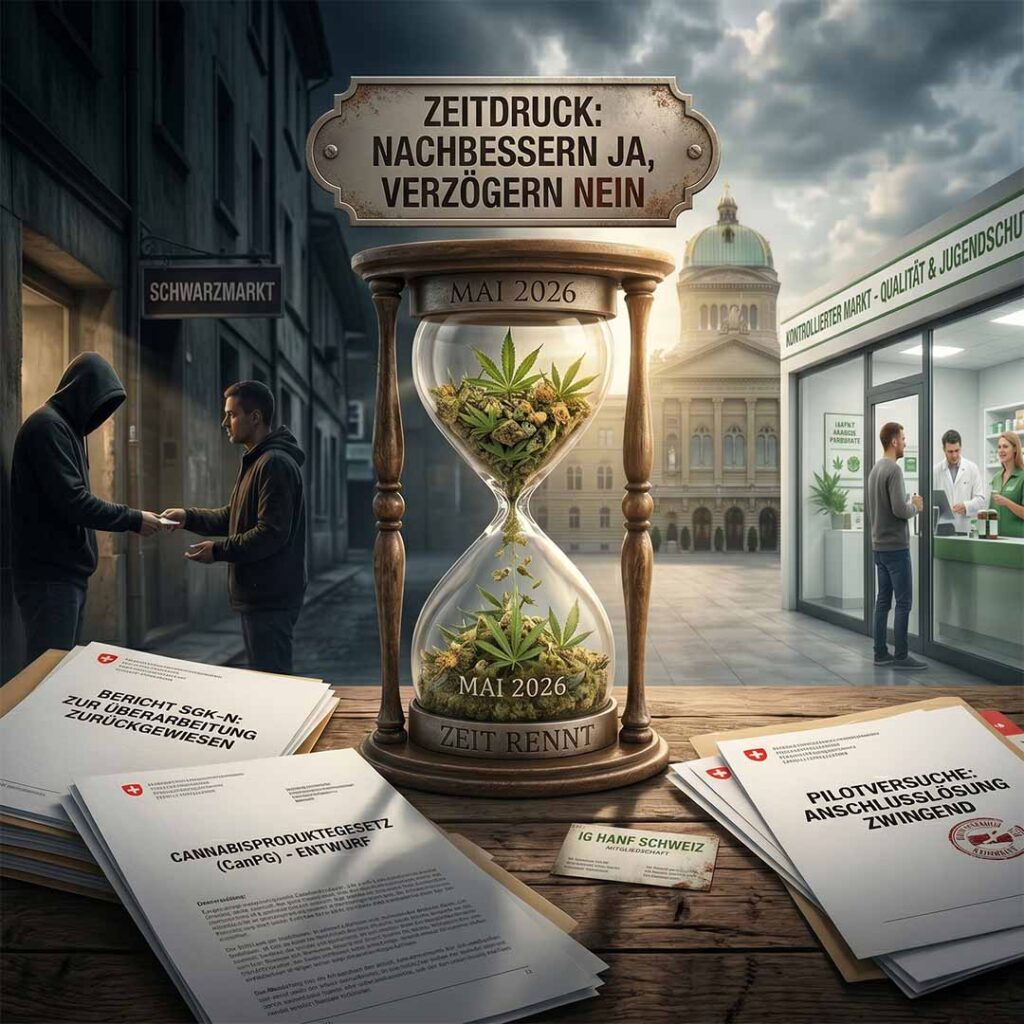
Current status of cannabis legalization in Switzerland: Improve yes, delay no
Despite the clear vision, the industry is currently urging haste. It was only on May 7, 2026 that the Health Committee of the National Council
(SGK-N) referred the draft bill back to the subcommittee for revision due to numerous proposed amendments. The industry association IG Hemp Switzerland supports this step towards a bill with majority support and more suitable for enforcement, but urgently warns against a political deadlock.
The message is clear: every additional month without regulation only strengthens the illegal market. As long as there is no legal basis, consumers will remain without state quality controls and without effective protection of minors. The industry is also calling for a binding follow-up solution for the ongoing pilot trials. If these trials end without an orderly transition, valuable data, investments and already functioning structures will be lost. Consumers would end up back on the streets, which is certainly not desirable in terms of health policy. This underlines exactly what we stand for: Regulation only works if it is implemented swiftly and counters the black market with a credible, legal and top-quality supply.
The step-by-step timetable for cannabis legalization in Switzerland until 2029
It is important to understand: The Federal Council has not yet set a start date in stone. However, the path from the current studies to comprehensive legality follows a clearly defined political rhythm. Based on the typical mills of Swiss legislation and current analyses by industry experts (such as the specialist portals Canna Viva and Snustrend), a very realistic timetable is emerging:
2026 – Evaluation and improvement: The Federal Council and the subcommittees use the data from the ongoing pilot trials as a basis and revise the draft law (CanPG) for the upcoming parliamentary debates.
2027 – Parliamentary decision and referendum deadline: National Council and Council of States discuss and pass the Cannabis Products Act. This process often takes a whole year. A positive decision is followed by the mandatory one hundred-day referendum period. The association and we as a company strongly assume that there will be a referendum. The SVP is likely to oppose the bill despite new findings and evidence from the current studies. In French-speaking Switzerland in particular, the debate is often compared to the laws on alcohol. In our view, some of the arguments are questionable and show that tradition and ideology are more important to certain political circles than health policy considerations and new scientific findings.
2028 – Setting up the infrastructure: Even if the law passes the councils, legal sales will not start the next day. During this transitional phase, the federal government must first establish the complete logistical and legal infrastructure for licensed cultivation, the new control authorities and the issuing of specialist store licenses.
2029 – Full legalization: If you add up all the political debates and bureaucratic set-up phases, this is the most realistic date when controlled and licensed sales can officially start for all Swiss residents of legal age.
Current legal situation: What applies until the cannabis reform with more than 1% THC?
Until the new law comes into force, the established Narcotics Act of the Federal Office of Public Health (FOPH) will continue to apply in Switzerland. There is an extremely important difference for consumers:
Cultivation & trade: Any sale and cultivation of cannabis with a THC content of over 1 percent is illegal outside of authorized pilot projects. A clear distinction is important here, as all CBD products with less than 1 percent THC are absolutely legal and freely available for sale in Switzerland.
Possession (carrying): The mere possession of up to 10 grams of cannabis with more than 1 percent THC for personal use is exempt from punishment. Anyone who merely carries this quantity with them will not receive a fine or be charged with a criminal offense. Logically, there are no such quantity restrictions for legal CBD.
Consumption: The actual consumption of cannabis with over 1 percent THC is still prohibited outside of the pilot projects. Anyone caught consuming cannabis will be fined CHF 100, but no entry will be made in the criminal register. The consumption of CBD flowers is and remains completely legal.
Conclusion: Why quality is the strongest argument for cannabis legalization in Switzerland

At Herba di Berna, we are convinced that the success of the upcoming regulation depends to a large extent on the quality and transparency of the products. Only a properly controlled market with laboratory-tested purity can make the illegal market superfluous in the long term. At the same time, the ongoing debate offers the opportunity to better educate the population about the body’s own endocannabinoid system and the conscious use of the plant.
We continue to follow this political path critically and in the meantime ensure that you will always find the usual Bernese quality for your legal enjoyment and your daily routine in our store.
FAQ zur THC Cannabis Legalisierung Schweiz 2026 für Prduckte mit mehr als 1% THC
Wann wird Cannabis in der Schweiz offiziell legalisiert?
According to the current timetable of the new Cannabis Products Act (CanPG), full national legalization is realistic for 2029 at the earliest. Until then, the scientific pilot trials will be extended until 2028 and evaluated in order to create a sound legal basis for parliament.
Wie sieht die aktuelle Rechtslage beim Besitz von THC-Cannabis aus?
The consumption of THC cannabis with over 1 percent THC is still prohibited in Switzerland outside of official pilot projects. However, possession of up to 10 grams for personal use is exempt from criminal charges and is instead punishable by a fine of CHF 100.
Warum setzt die Schweiz auf wissenschaftliche Pilotversuche statt auf das deutsche Modell?
Switzerland wants to avoid mistakes such as the excessive bureaucracy of the German cultivation associations and instead relies on evidence-based data from practice from the outset. The first evaluations of the Swiss projects show that controlled dispensing in pharmacies and social clubs with expert advice is much more effective in suppressing the black market.
Welche Lehren zieht die Schweiz aus der Teillegalisierung in Deutschland?
The most important lesson is that mere legislative changes without a functioning and unbureaucratic infrastructure will not be able to push back the illegal market in the long term. Switzerland is therefore planning a customer-friendly but strictly controlled dispensing model that places quality and the protection of minors above commercial interests.
Was regelt das neue Cannabisproduktegesetz (CanPG) genau?
The CanPG provides for a strictly regulated, licensed and non-profit-oriented sale of cannabis to adults aged 18 and over. The bill focuses on consistent health protection, a strict ban on advertising and seamless “seed-to-sale” tracking for complete control of the market.
Warum spielt die Schweizer Hanfkultur eine so grosse Rolle?
Switzerland can look back on a long tradition of hemp cultivation, ranging from the historic scented bags to today’s high-tech indoor facilities. This deep-rootedness ensures a high level of social acceptance and forms the basis for an objective political debate on regulation.
Wer darf künftig in der Schweiz legal Cannabis kaufen?
After the planned full legalization from 2029, controlled purchase should be possible for all adults in Switzerland aged 18 and over. Currently, the purchase of products containing THC is only legal for registered participants within the regional pilot studies approved by the FOPH. Another important exception is medically indicated use. In these special cases, cannabis can be obtained on a doctor’s prescription, although the costs of these treatments are very rarely covered by health insurance.
Wie wird der Jugendschutz im kommenden Gesetz verankert?
The protection of minors is guaranteed by a strict national ban on advertising, mandatory age checks on sales and compulsory information on distribution. In addition, consumption in public spaces near schools or youth facilities remains strictly prohibited.
List of sources
- Federal Office of Public Health (FOPH) – New Cannabis Products Act: Official status reports on the new Cannabis Products Act (CanPG) and the legal framework.
- IG Hanf Schweiz – What the consultation on the CanPG really shows: Statements and media releases on the consultation of the Cannabis Products Act and the current decisions of the SGK-N (May 2026).
- Snustrend – THC legalization Switzerland 2026:Your compact guide: Industry reports, analysis on European partial legalization and forecasts on the gradual Swiss roadmap to 2029.
- Swiss Parliament – Media releases of the SGK-N: Documentation on the parliamentary initiative 20.473 and the consultation procedures of the Social Security and Health Commission.
- Hemp Magazine: CanG Interim Report April 2026: What legalization is really doing to the black market
- IG Hemp Switzerland: Information on current hemp policy and regulation
- Canna Viva – Cannabis legalization Switzerland (live updates on legislation): Current reports and timed forecasts on the progress of the Cannabis Products Act (CanPG) and Swiss legalization.
- Herba di Berna Blog: Cannabis regulation in Switzerland: Better than Germany does not mean “doing nothing”
Also discover the rest of the Herba di Berna range
- Suitable CBD accessories for perfect enjoyment.
- High-quality hemp foods for a conscious diet.
- Everything for your own CBD grow or get a strong CBD cutting.